

This guide outlines the core electrical and physical selection criteria for 6 AWG cable applications. It includes detailed current-carrying capacity and voltage drop conversion rules to help project engineers and advanced modification specialists effectively avoid potential issues related to heat generation and voltage drop in low-voltage DC system wiring.
As an industry expert with 28 years of experience in customizing specialized, highly flexible wiring harnesses, DÂY strictly adheres to the Tiêu chuẩn ISO 9001 quality management system, delivering high-quality, zero-defect custom wiring harness assemblies.
Avoid the risks of reduced battery life and localized overheating caused by trial-and-error with low-quality, inflexible wires. Liên hệ DÂY’ professional engineering team today to receive a customized solution and a rapid prototyping quote!
AWG stands for American Wire Gauge.
It represents the American wire gauge standard.
Simply put:
The smaller the AWG number, the thicker the conductor.
The larger the AWG number, the thinner the conductor.
For example:
Many buyers believe that AWG simply refers to conductor thickness.
In reality, it also affects:
Especially in high-frequency motion equipment.
Incorrect AWG specifications often lead to higher failure rates.
As industrial automation advances,
equipment operates at increasingly higher frequencies.
Traditional cables can no longer meet the demands of complex motion environments.
This is particularly true in:
In these types of equipment,
standard PVC cables are prone to internal strand breaks after prolonged bending.
Many devices operate normally at first,
but after a few months, issues begin to arise:
These issues are fundamentally related to the design of the cable harness structure.
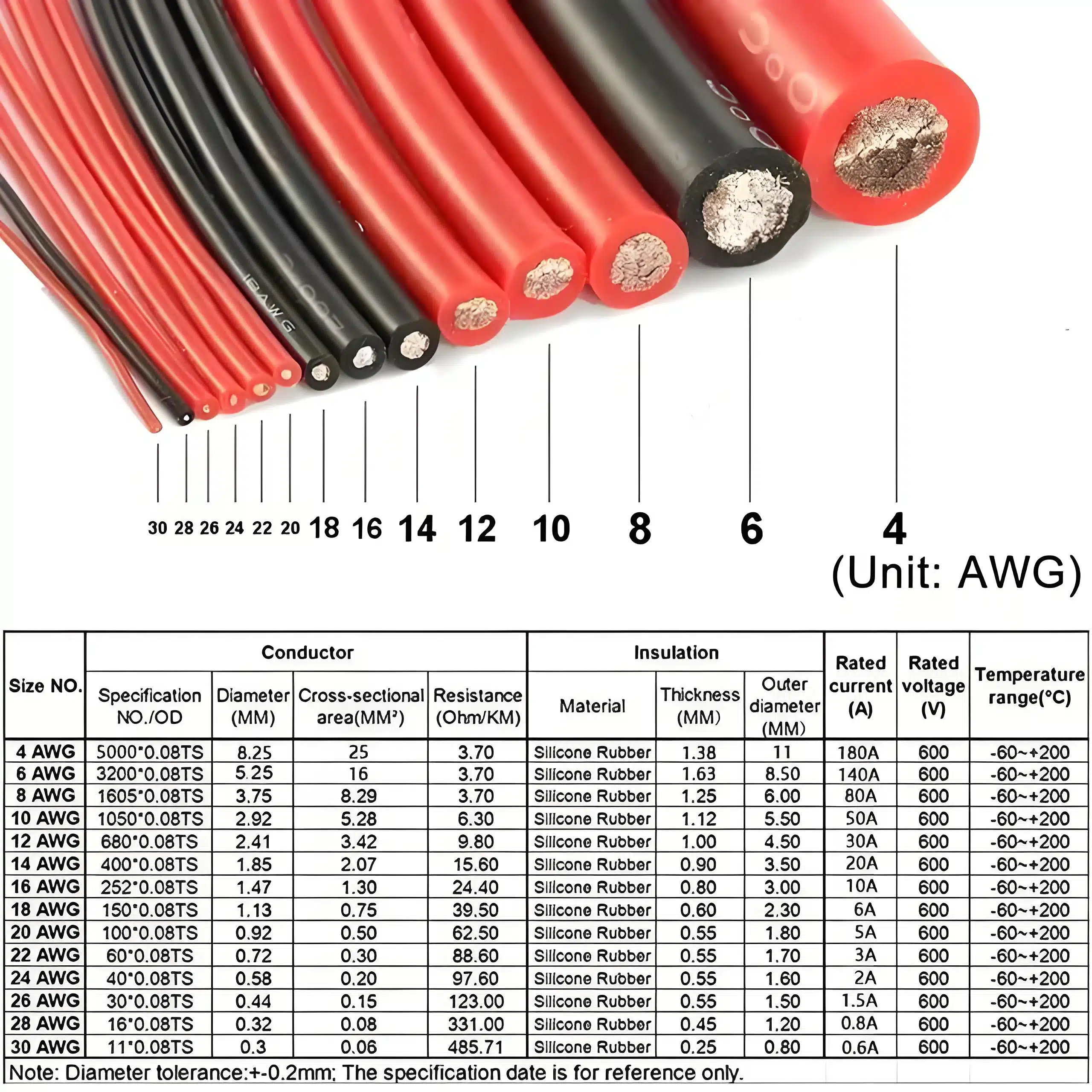
A standard 6 AWG solid single-strand copper conductor has a legally defined physical diameter of exactly 4.115 mm, corresponding to an actual electrical cross-sectional area of approximately 13.3 square millimeters.
However, in practical wiring scenarios where physical flexibility is critical—such as in the confined spaces of RVs, the winding concealed conduits of yachts, and car audio upgrades—rigid solid copper wire is unsuitable due to its extreme difficulty in bending.
To completely eliminate spatial constraints, DÂY employs an ultra-flexible composite core structure precision-twisted from hundreds or thousands of micro-fine pure copper wires (such as 0.08 mm or 0.16 mm oxygen-free copper wires).
Although this multi-strand twisting process slightly increases the external physical diameter to between 5.0 mm and 6.5 mm, the equivalent core cross-sectional area remains strictly within the statutory standard of 13.3 square millimeters.
Through this microscopic physical restructuring, DÂY ensures that every custom-made 6 AWG component possesses both the excellent electrical characteristics of standard wire gauge and the silky-smooth resistance to physical bending.
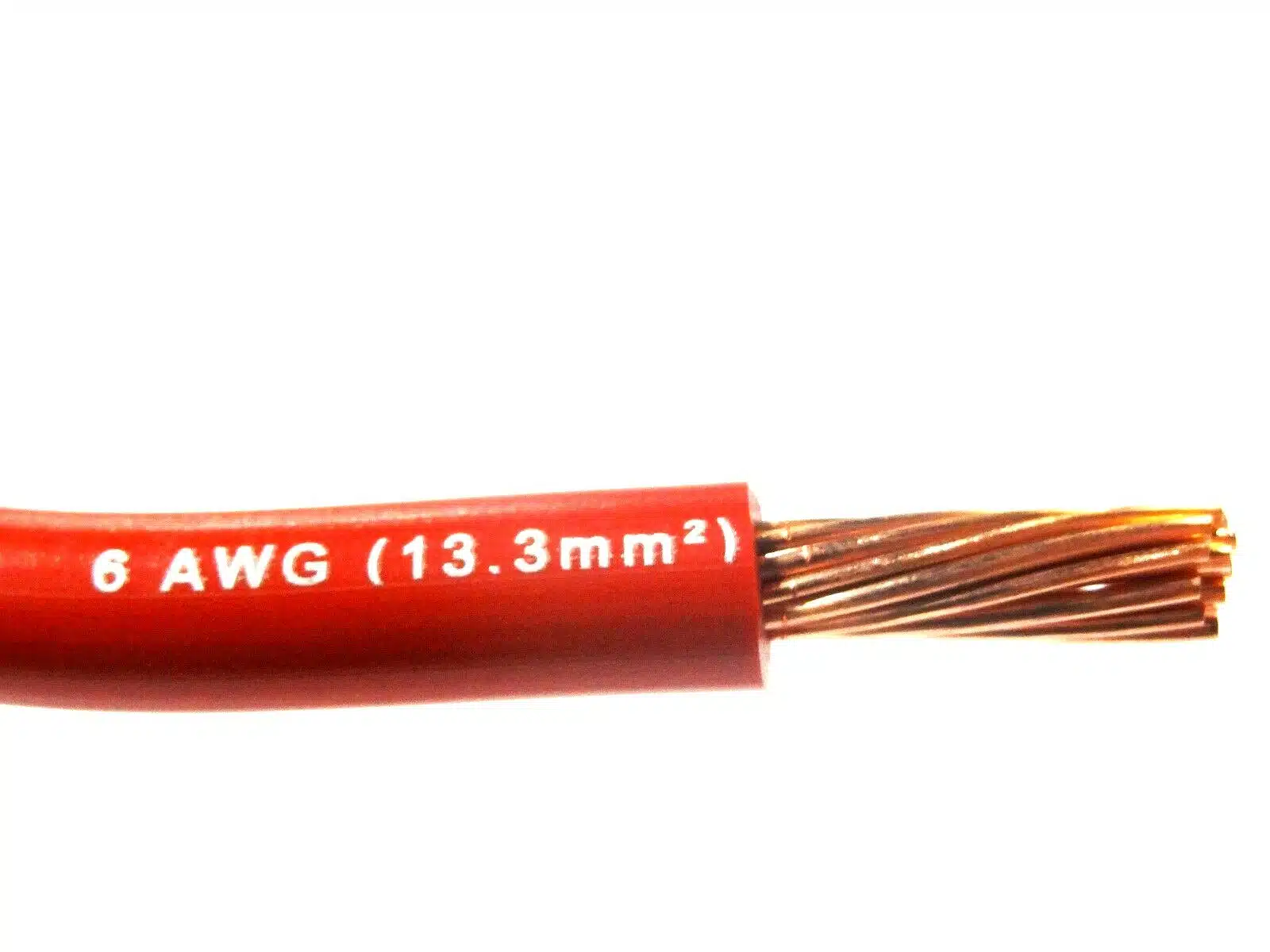
Regarding the specific amount of continuous current that a 6 AWG cable can safely carry in practical applications, the engineering community and the National Electrical Code (NEC) require a scientific definition based on boundary conditions.
The conductor’s rated current-carrying capacity (ampacity) is by no means a static, unchanging value; it depends heavily on the maximum operating temperature of the insulation material and the ventilation and heat dissipation conditions of the external environment.
When encased in standard 60°C-rated insulation (such as conventional residential TW wire), the safe continuous current-carrying capacity of 6 AWG copper wire in air is strictly limited to 55 amps.
If the outer sheath material is upgraded to a 75°C temperature rating (such as common THWN wire), its safe continuous current-carrying capacity can be increased to 65 amps.
In the extremely confined spaces of RV battery compartments or home energy storage cabinets, where heat buildup is highly likely, DÂY recommends and exclusively uses specialty polymer materials with heat resistance ratings of 90°C or even 125°C and above, thereby safely increasing the steady-state rated current capacity to 75 amps or even 95 amps.
$$\Delta T = I^2 \cdot R \cdot R_{\text{th}}$$
By rigorously substituting ambient temperature into the Joule heat balance equation for calculation, DÂY can assist your technical team in identifying the safest current-carrying capacity threshold, completely eliminating the risk of insulation melting.
Once the physical limits of safe continuous current carrying capacity are established, calculating the total safe power load (in watts) that 6 AWG wire can handle in an actual system requires substituting the system’s actual operating voltage.
According to the fundamental physical formula for power, total power equals the product of operating voltage and current. This means that changes in voltage levels directly affect the power transmission density of the wiring harness.
In a conventional 12-volt DC RV low-voltage power circuit, based on a safe current-carrying capacity of 75 amps at 90°C insulation temperature, the maximum continuous power that 6 AWG cable can support is only 900 watts.
However, when this same wire is used in modern mainstream 48-volt low-voltage residential solar energy storage systems (such as the busbar of a common lithium iron phosphate battery pack), the total power carried by that single wire instantly surges to 3,600 watts.
If deployed in a 240-volt AC residential Level 2 EV charging station or a residential heavy-duty electric oven circuit, this wire can easily and safely support an extremely high power load of up to 18,000 watts (18 kW).
DÂY’ custom engineering services closely analyze the transient peak wattage and dynamic voltage fluctuations of your specific equipment to scientifically select the optimal dielectric insulation, ensuring absolutely no risk of localized arc breakdown during high-power transmission.
During the wiring of high-power household appliances and electrical systems in outdoor RVs and yachts, improper installation methods and reckless space compression are often the primary causes of subsequent circuit failures.
When multiple 6 AWG cables are tightly bundled within the same fully enclosed RV cable tray with no air circulation, a severe physical heat accumulation effect occurs between the conductors.
According to international electrical engineering standards, when multiple high-current-carrying conductors are laid in parallel, a non-linear current-carrying capacity derating factor must be applied, typically reducing the rated amperage by 10% to 30%.
Furthermore, due to the continuous low-frequency vibrations generated by RVs while driving on roads and the constant rocking of yachts in waves, wiring harnesses are highly susceptible to physical wear when passing through the sharp edges of wooden or metal partitions.
DÂY strongly recommends that custom 6 AWG wiring harness assemblies be covered with highly flexible, abrasion-resistant braided mesh or UV-resistant corrugated tubing at wall penetrations and high-friction areas.
At the same time, we fully equip crimped terminals with double-wall adhesive heat-shrink tubing and corresponding stress-relief sleeves to ensure that long-term vibration stress is absolutely prevented from being transmitted to the fragile metal connection points of the terminals.
Depending on the specific climatic and environmental constraints of different residential segments, 6 AWG conductors must be encased in completely different types of functionally modified polymer sheathing materials.
Selecting the wrong cable type often leads to the complete failure of the entire electrical network within just a few months of use due to hardening, cracking, or mold growth of the outer sheath.
For residential solar power generation and ground-level energy storage room wiring, UL 4703-compliant PV Wire—a cable specifically designed for solar applications—is the absolute top choice, offering unmatched resistance to long-wave UV radiation and extreme outdoor weathering.
Conversely, for marine yacht electrical systems that are exposed year-round to moisture, high salt fog corrosion, and bilge oil and water accumulation, it is essential to strictly use special marine-rated tinned copper cables that comply with the UL 1426 standard.
For high-end car audio amplifier upgrades or compact RV battery compartment applications requiring extreme bending, DÂY has specifically introduced ultra-flexible silicone rubber or highly elastic elastomer-insulated cables.
While maintaining maximum heat resistance, the unique multi-strand fine copper wire braided construction of these cables provides unparalleled bending flexibility, significantly reducing installation difficulty.
In large-scale residential rooftop solar wiring, remote landscape power distribution in gardens, or main busbar interconnections from stern to bow on yachts, distance is the critical factor determining the success of 6 AWG cable ứng dụng.
As the total length of the wiring ($L$) increases in one direction, even high-purity copper conductors accumulate their own trace DC resistance into a significant impedance.
When high-ampere currents flow through this long-distance resistance, a portion of the voltage is dissipated along the conductor according to Ohm’s Law, resulting in a severe physical voltage drop at the end-use equipment.
$$\Delta U = I \cdot R = I \cdot \left( \frac{\rho \cdot L}{S} \right)$$
For low-voltage DC systems operating at 12 or 24 volts, even a mere 1-volt drop can cause the inverter to trigger frequent under-voltage alarms, or even prevent electrical devices from starting due to insufficient power.
This means that in long-distance wiring scenarios, the actual allowable continuous current carrying capacity of 6 AWG cable must undergo significant passive mathematical derating as the distance increases.
DÂY’ powerful engineering database can precisely calculate the maximum allowable wiring distance based on your end-point voltage drop limit (typically strictly controlled within 3%). If the limit is exceeded, it assists you in smoothly upgrading to a larger wire gauge or implementing custom terminal impedance compensation.
Q: Are there any key physical differences in electrical current-carrying capacity between 6 AWG multi-strand high-flex cables and consumer-grade single-strand solid wires?
A: Under identical ambient operating temperatures and insulation materials, the effective cross-sectional area for pure DC current is exactly the same for both, so there is virtually no physical difference in rated current-carrying capacity under steady-state DC conditions.
However, in physically dynamic environments such as RVs and yachts where continuous vibration occurs, solid-core wire is highly susceptible to metal fatigue failure and is difficult to route; multi-strand high-flex wire is the absolute safety standard for interconnecting such mobile equipment.
Q: I am retrofitting an RV. For a 2000W inverter in a 12V system, can I simply select standard 6 AWG cable available on the market?
A: This is a classic example of dangerous overloading from an engineering perspective.
When a 2000-watt inverter operates at full load on a 12-volt system, the dynamic continuous current draw can exceed 160 amps—far surpassing the 75-amp safety limit of 6 AWG cable. Under these conditions, you will need to use two 6 AWG wires in parallel, or contact DÂY directly to have us custom-manufacture a dedicated, high-flex battery connection harness using thicker gauge wire (such as 1/0 AWG or 2/0 AWG).
Q: Why do WIRES’ custom 6 AWG wiring harness assemblies maintain zero contact resistance degradation over the long term in marine salt fog environments?
A: Because we have completely eliminated the low-end manual crimping of ordinary bulk wire, instead fully adopting high-end precision hydraulic crimping equipment equipped with a Terminal Crimping Management (CHM) online monitoring system.
The terminals we use feature a thickened outer layer treated with a special tin-plating process, and the crimped joints are further covered with double-wall, waterproof, adhesive-coated heat-shrink tubing. This ensures a perfect molecular-level cold-weld bond between the metal substrate and the terminal, completely isolating it from external air and moisture, thereby eliminating the risk of salt fog oxidation at the source.
Chất lượng cao 6 AWG cable applications are by no means a mere haphazard assembly of basic raw materials, but rather a system-level guarantee resulting from the seamless integration of electrical physics, structural design, and polymer science.
DÂY consistently approaches core electrical components with the utmost rigor and reverence, implementing meticulous management throughout the entire lifecycle of our one-stop manufacturing process—from conductor refining, specialized multi-strand stranding, and functional jacket extrusion to fully closed-loop crimping and injection molding at the cable ends.
Click “Get Engineering Solution” now, and WIRES’ team of senior expert engineers will provide you with a completely free technical feasibility assessment and a customized sample quotation within 24 hours, working together to build a safe and efficient power bridge!
 English English
 Vietnamese
 Indonesian
 Arabic
 Spanish