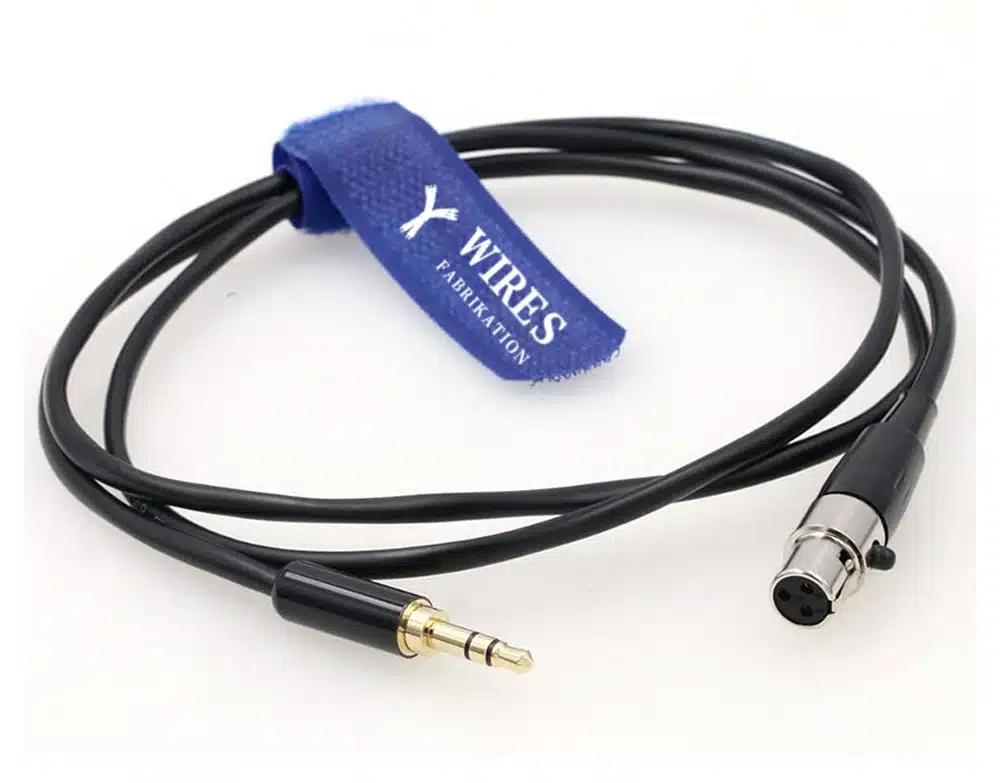



A TRS cable uses a tip, ring, and sleeve contact system, but those three contacts do not define one universal signal. Depending on the equipment, TRS may carry balanced mono audio, unbalanced stereo audio, an insert send/return path, control signals, or another documented circuit. Select and customize the cable from the exact pinout and device manuals, not from plug appearance alone.
This guide focuses on TRS cable construction, plug sizes, wiring functions, connector options, materials, and custom specification. For a broad TS-versus-TRS selection guide, read 1/4-inch audio cables: TS vs TRS. For hum diagnosis, use the separate TRS ground-loop noise guide.
TRS stands for tip, ring, and sleeve. Insulating bands separate the three conductive plug sections. A cable normally contains conductors and shielding arranged for the intended circuit, but the same plug can support several functions.
| TRS application | Typical contact use | Important check |
|---|---|---|
| Balanced mono line | Tip and ring carry opposite-polarity signal components; sleeve is the shield or reference | Both source and destination must implement compatible balanced interfaces |
| Unbalanced stereo | Tip is commonly left, ring right, and sleeve common return | Verify headphone, line, and equipment wiring |
| Insert cable | Tip and ring commonly serve send and return through a breakout | Direction and console pinout vary |
| Control or footswitch | Contacts carry device-specific switching or control | Audio assumptions may be wrong |
| TRS MIDI | Contacts carry a MIDI mapping | Type A and Type B assignments differ |
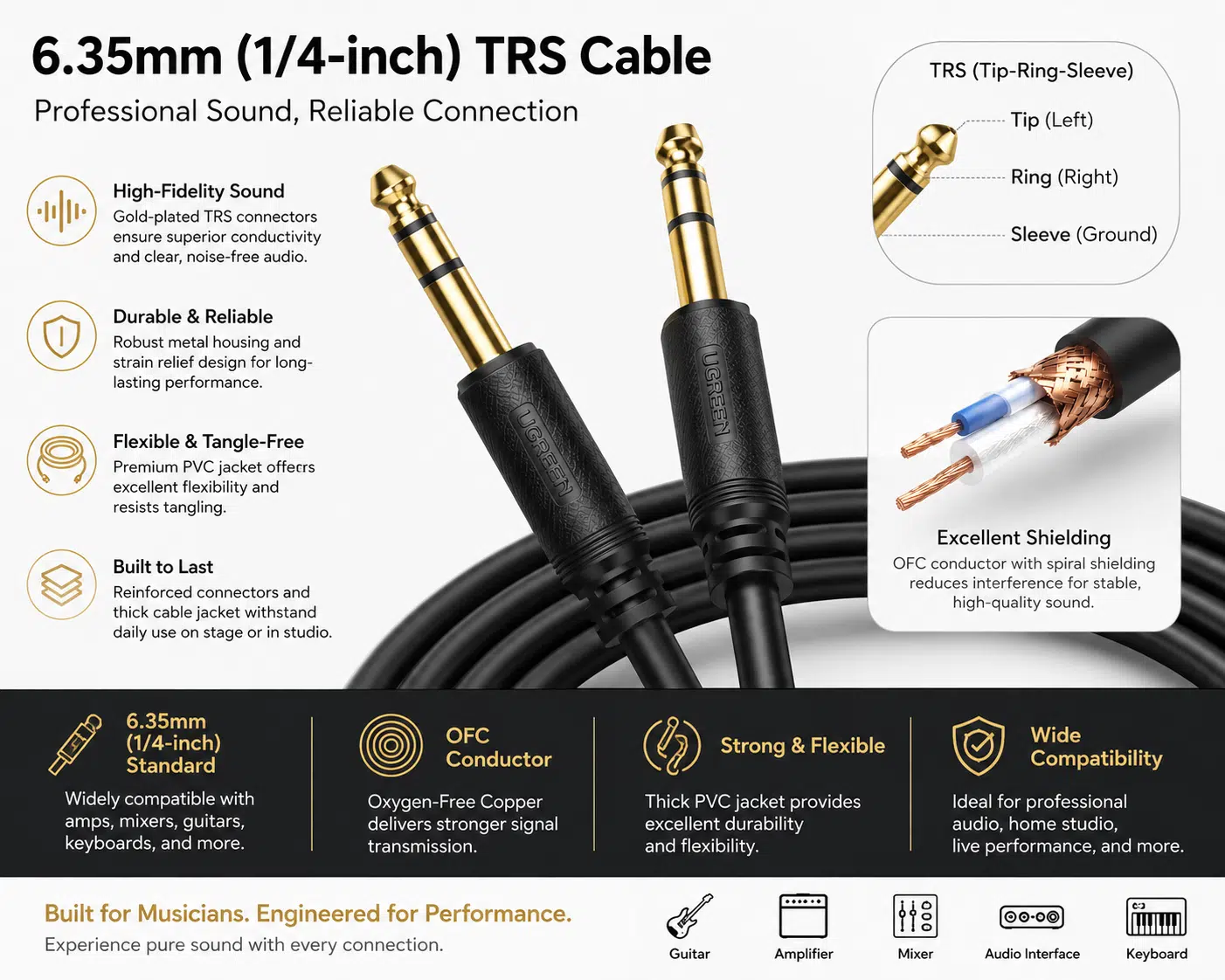
The 6.35 mm plug is common on mixers, interfaces, patch bays, keyboards, headphones, and professional audio equipment. Straight and right-angle versions, metal or molded shells, and different cable-entry diameters are available. Mechanical size does not prove balanced wiring.
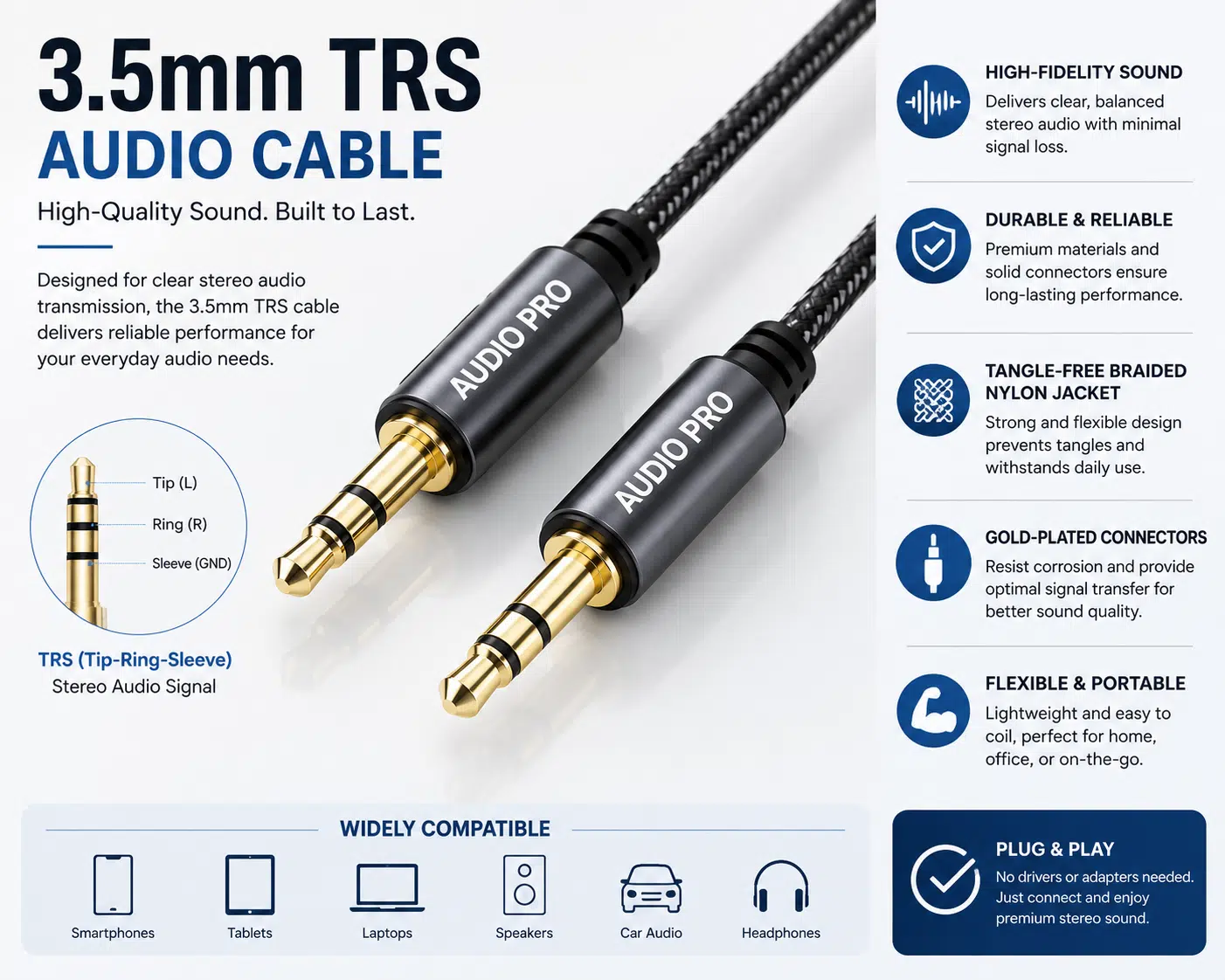
The 3.5 mm TRS connector is common on computers, portable audio equipment, cameras, recorders, and consumer devices. A three-contact TRS plug may carry stereo audio, but headset microphones and button controls commonly require four-contact TRRS wiring instead. Check the socket symbol and manual.
The smaller 2.5 mm connector appears on selected radios, controls, cameras, and legacy devices. Similar appearance does not establish the contact assignment, so specify the exact device and plug dimensions.
| الموصل | Contacts | Common functions | Compatibility limit |
|---|---|---|---|
| تي إس | Tip and sleeve | Unbalanced mono instrument, line, speaker, switch, or control circuits | Function and power handling depend on equipment and cable construction |
| TRS | Tip, ring, sleeve | Balanced mono, unbalanced stereo, insert, control, or MIDI | Three contacts do not automatically mean balanced audio |
| TRRS | Tip, two rings, sleeve | Stereo headset audio plus microphone or device-specific functions | CTIA, OMTP, and proprietary mappings may differ |
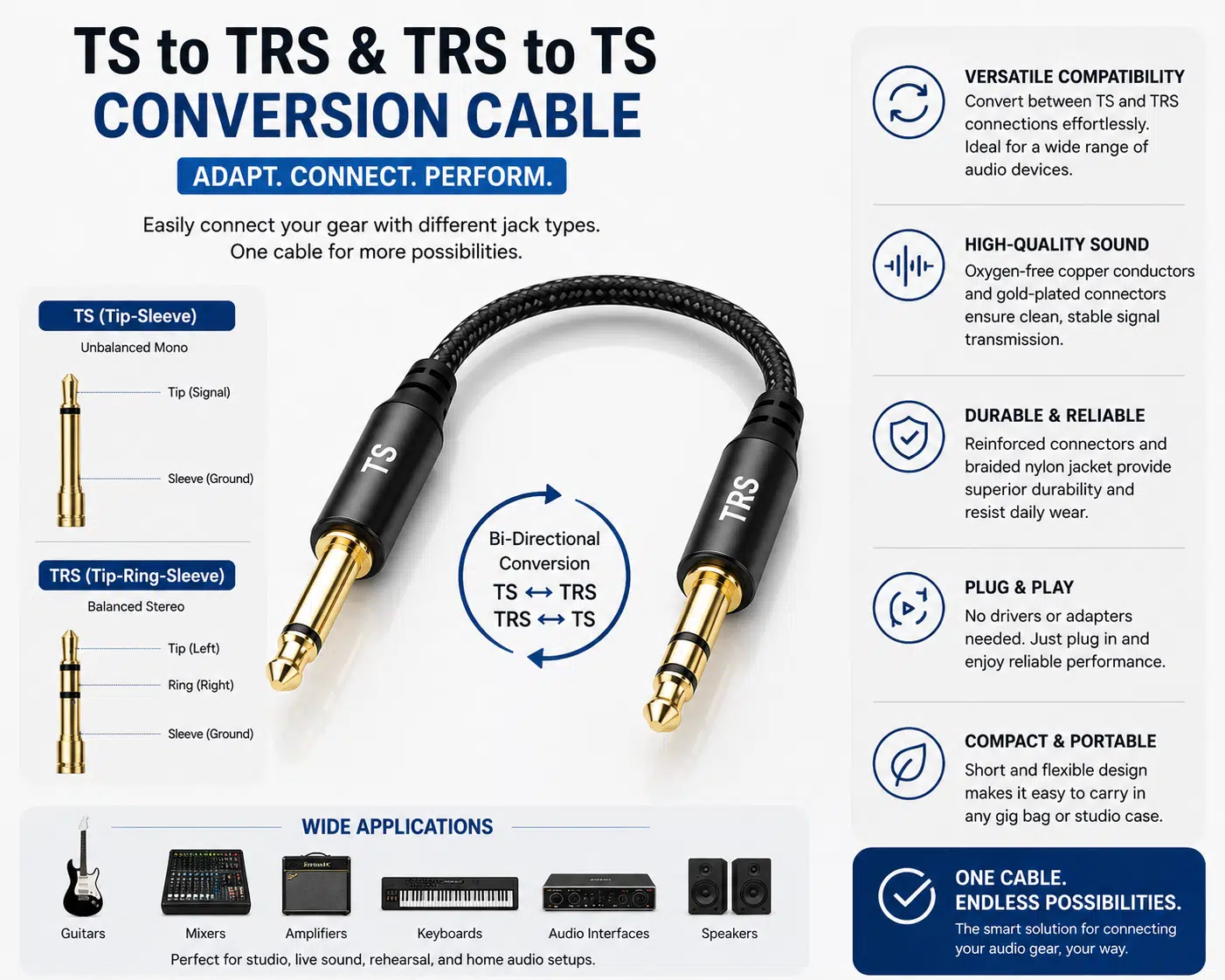
Substituting TS and TRS can short or combine contacts, unbalance a circuit, silence one channel, or change device behavior. It does not provide a reliable bidirectional conversion. Confirm the jack contacts and circuit before substitution.
TRS and XLR can both carry balanced mono audio when the connected equipment is wired compatibly. XLR commonly provides a latch and a defined three-contact shell, while standard phone plugs use friction retention and allow compact patching. Neither connector is universally better.
| Factor | TRS | XLR |
|---|---|---|
| Retention | Usually friction fit; locking variants exist | Many audio versions include a latch |
| Space | Compact and common on patch bays and interfaces | Larger shell with clear pin identification |
| Hot plugging | Contacts may momentarily connect in sequence during insertion | Contact sequence depends on connector design |
| الوظيفة | Balanced, stereo, insert, control, or other wiring | Balanced audio, microphones, lighting/control, power, or other wiring depending on series |
A TRS-to-XLR cable is passive only when it routes compatible analog signals. It cannot create balancing, microphone power compatibility, gain, isolation, or protocol conversion.
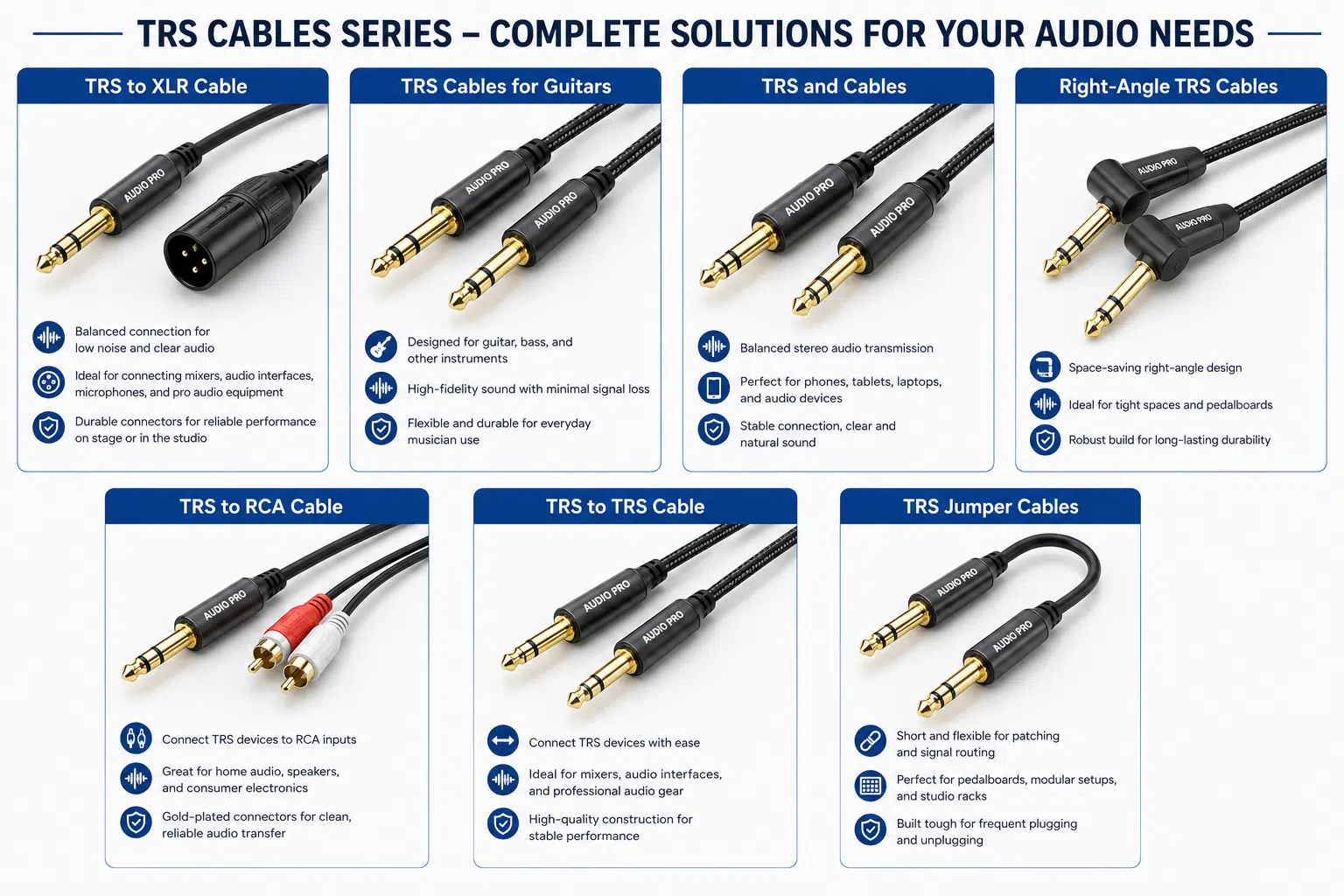
| التجميع | Typical use | Specification questions |
|---|---|---|
| من TRS إلى TRS | Balanced line, stereo, patching, or control | Plug size, wiring function, direction, straight or right-angle exits |
| TRS to XLR | Compatible balanced line connections | XLR gender, pin mapping, shield termination, source and destination circuits |
| TRS insert breakout | Mixer or processor send and return | Tip-send or ring-send convention, branch labels, length, and direction |
| TRS to dual RCA | Stereo breakout or two-channel unbalanced path | Left/right mapping, source level, destination input, and grounding |
| Right-angle TRS | Racks, instruments, panels, and tight enclosures | Clocking direction, adjacent-port clearance, bend transition, and service access |
| TRS patch cable | Patch bays, effects, and rack routing | Patch-bay format, normaling, length, flexibility, labels, and handling |
| المكوّن | Design effect | Evidence to define |
|---|---|---|
| الموصلات | Resistance, flexibility, termination, and cable diameter | Material, strand construction, size, and measured resistance conditions |
| Pair geometry | Noise rejection and capacitance in balanced analog circuits | Twist, insulation, capacitance target, and application |
| Shield | Noise coupling and ground-current path | Foil, braid, spiral, drain, coverage method, and termination |
| Plug contacts | Mating fit, resistance, wear, and corrosion behavior | Exact connector manufacturer, part number, plating, and ratings |
| Jacket | Flexibility, abrasion, chemicals, temperature, and handling | Material data and project environment |
| Strain relief | Bend transition and termination loading | Geometry, overmold material, handling profile, and test criteria |
Gold-colored contacts, oxygen-free copper, thick cable, or a fixed shielding percentage do not independently guarantee sound quality. Evaluate the complete source-cable-destination system. For molded exits and identification, review تجميعات الكابلات المصبوبة فوق بعضها البعض.
For mixed audio and control assemblies, use the industrial AV assembly guide. WIRES can review a design through its custom cable process and build a تجميع كابل النموذج الأولي before production release.
| العَرَض | Possible causes | Checks |
|---|---|---|
| No sound or one missing channel | Wrong TS/TRS/TRRS format, partial insertion, broken conductor, or incorrect pinout | Confirm the jack function, inspect insertion, and test continuity against the drawing |
| Hum or buzz | Ground loop, unbalanced interface, shield path, power coupling, or equipment fault | Map grounding, compare a short known-compatible cable, and never defeat protective earth |
| Signal drops when moved | Conductor fatigue, loose plug, poor termination, or inadequate strain relief | Inspect each end and reproduce movement under controlled conditions |
| Distortion | Wrong level, incompatible input, shorted contact, damaged plug, or equipment setting | Verify source and destination levels, pinout, plug format, and device configuration |
| Insert send/return reversed | Tip/ring convention mismatch or mislabeled breakout | Compare the console manual with the cable drawing and branch labels |
When the project requires a labeled breakout, multichannel loom, panel lead, or equipment-specific channel map rather than a standard cable, review the custom TRS cable assemblies integration guide.
No. TRS may carry balanced mono, unbalanced stereo, insert send/return, control, MIDI, or another circuit.
Yes, when the source and destination use tip for one channel, ring for the other, and sleeve as the common return.
Many passive guitars use TS unbalanced outputs. Some instruments, pedals, switches, and balanced outputs use TRS. Check the exact equipment.
No. The cable can route compatible balanced contacts, but it cannot make an unbalanced source balanced or correct incompatible levels and grounding.
TRS has three conductive contacts; TRRS has four. TRRS headset mappings can differ, so connector fit alone does not prove compatibility.
No. Hum can arise from equipment grounding and system topology. Cable construction matters, but it cannot fix every ground loop.
Provide device models, function, pinout, plug size, connector orientation, length, environment, labels, expected order range, and test criteria.
Review the supplier’s cable and harness quality controls, then contact WIRES with equipment manuals, port photos, pinout, length, connector orientation, environment, and validation requirements.
 English English
 Vietnamese
 Indonesian
 Arabic
 Spanish