

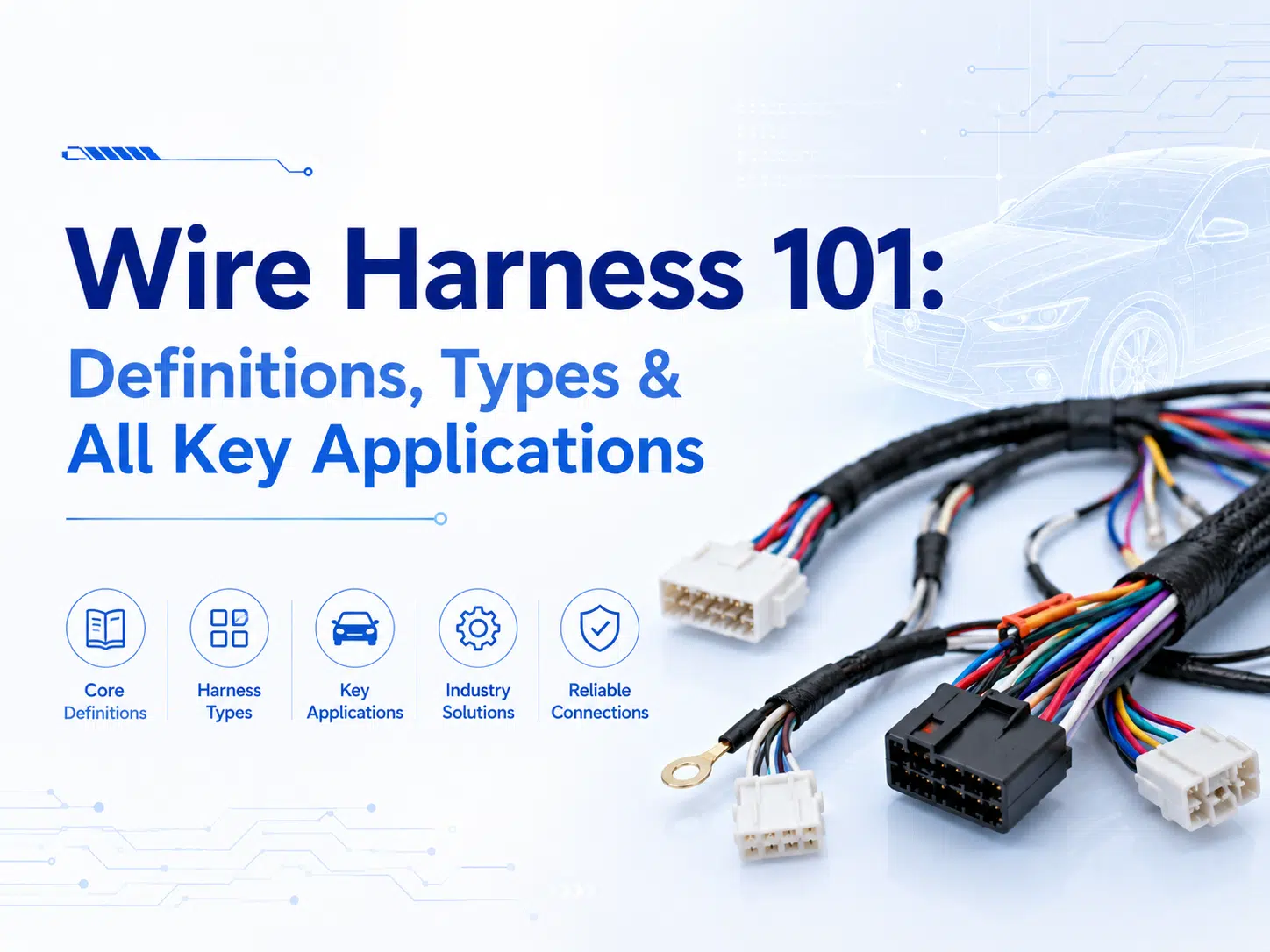
Quick answer: A wire harness is an organized assembly of insulated wires, cables, terminals, connectors, splices, seals, labels, and protective materials that distributes electrical power and signals through a machine or product. Its layout is designed for specific circuits, interfaces, routing space, environment, manufacturing process, and inspection requirements.
A harness does more than bundle loose wires. It controls branch locations, connector orientation, circuit identification, abrasion protection, strain relief, service access, and repeatable installation. The drawing, bill of materials, and test requirements define the harness; the outer tape or sleeve is only one part of the system.
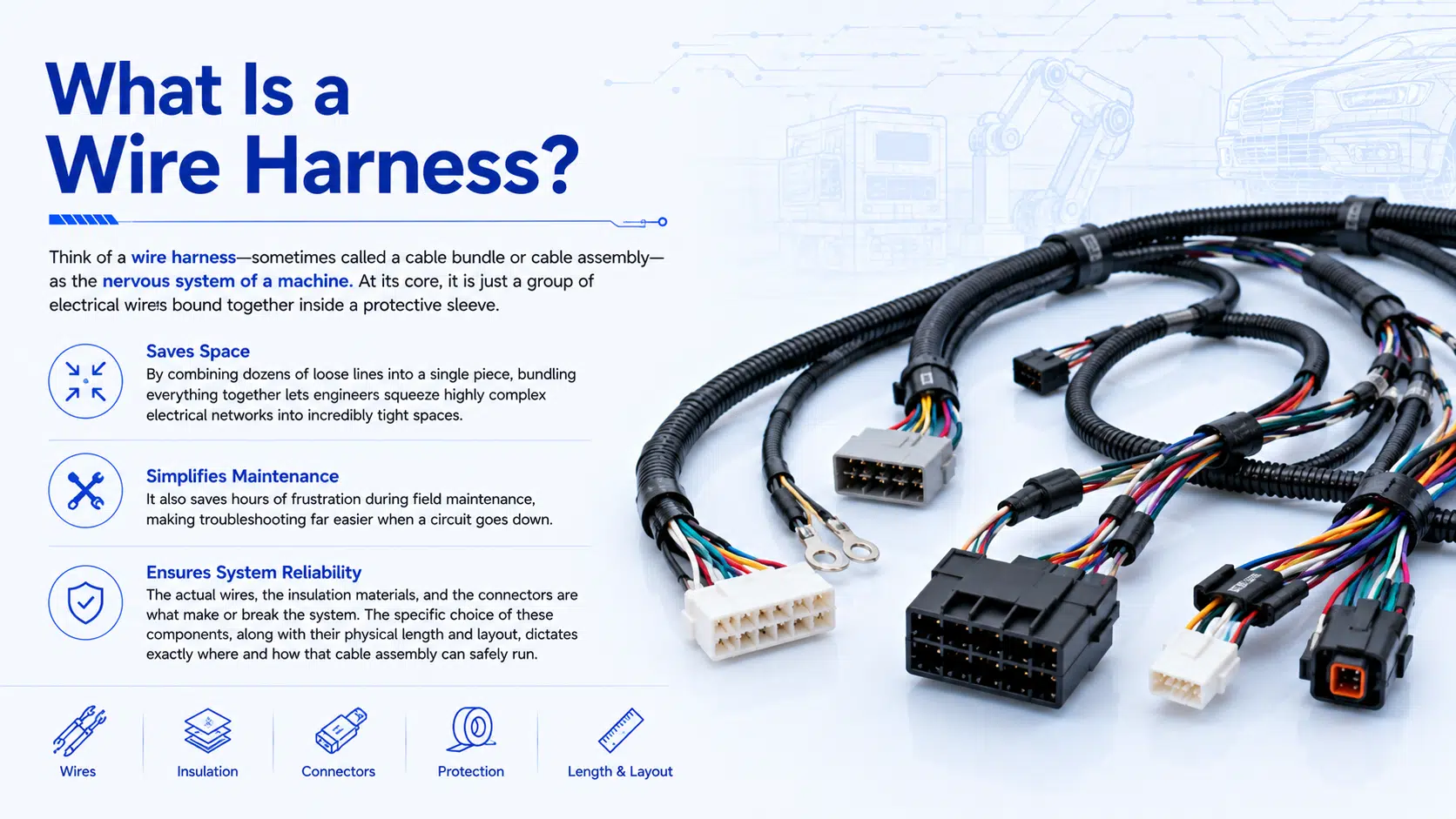
| Term | Typical meaning | Common construction | Important note |
|---|---|---|---|
| Dây | One electrical conductor with insulation | Solid or stranded conductor plus insulation | Wire type and size must suit the circuit and environment |
| Dây cáp | One or more conductors manufactured as a cable product | Conductors, insulation, fillers, shield, and common jacket as applicable | May carry power, data, RF, video, or control signals |
| Wire harness | An application-specific routed assembly with multiple circuits or branches | Wires or cables, terminals, connectors, splices, protection, labels, and attachments | Often optimized for installation inside equipment or vehicles |
| Cable assembly | A terminated cable or group of cables supplied as one functional assembly | Jacketed cable, connectors, backshells, strain relief, shielding, and overmold as needed | The term can overlap with wire harness in industry usage |
The terms are not always used consistently. Buyers should rely on the drawing and construction requirements rather than the label alone. See the detailed wire harness vs. cable assembly guide.
A harness cannot compensate for an incorrect electrical design. Conductor size, circuit protection, grounding, connector ratings, spacing, shielding, and validation still need engineering review.
| Thành phần | Chức năng | Selection inputs |
|---|---|---|
| Dây và cáp | Carry electrical power, signals, data, or RF energy | Voltage, current, frequency, impedance, temperature, flexibility, environment |
| Terminals and contacts | Create the electrical interface between conductor and connector | Wire range, material, plating, mating system, tooling, current and environment |
| Connector housings | Position, insulate, key, lock, and protect contacts | Cavity count, mating interface, retention, sealing, service and package space |
| Seals and cavity plugs | Limit water, dust, or fluid entry in specified connector systems | Wire insulation diameter, cavity, connector series, mating and test condition |
| Splices | Join one circuit to one or more branches | Current, conductor combination, process, insulation, strain and sealing |
| Shielding and drain wires | Support electromagnetic compatibility and signal integrity | Interface, frequency, grounding architecture, termination and routing |
| Tape, sleeving, conduit and jackets | Bundle and protect circuits | Abrasion, fluids, temperature, flame, flexibility, noise and service access |
| Grommets, boots and overmolds | Protect entries, breakouts, terminations, and transitions | Geometry, strain relief, sealing, material compatibility and tooling |
| Clips, clamps and fasteners | Control harness position and mechanical loading | Mounting surface, vibration, spacing, installation method and serviceability |
| Labels and markers | Identify assemblies, branches, circuits, revisions, or traceability | Content, location, durability, readability and customer format |
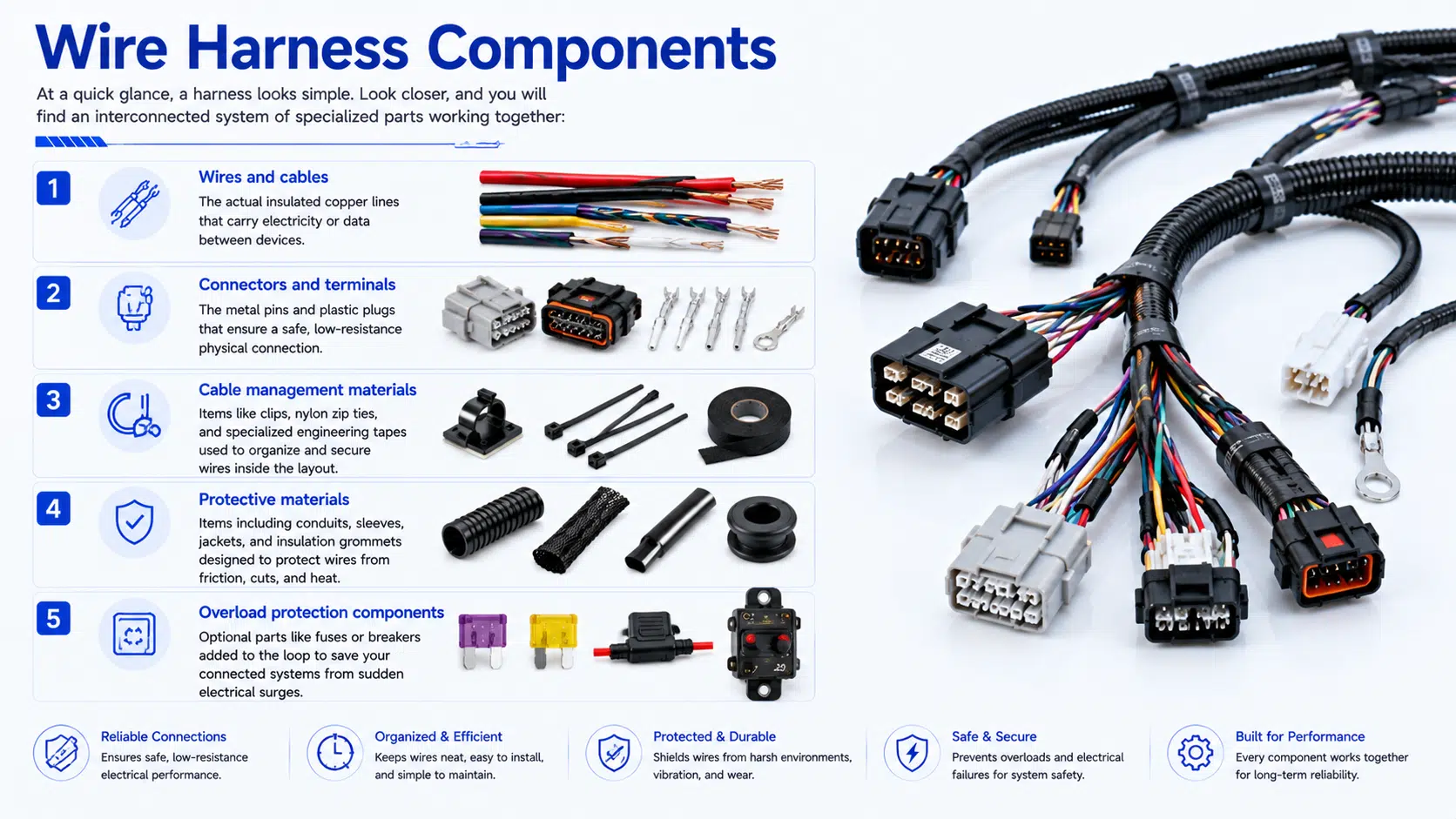
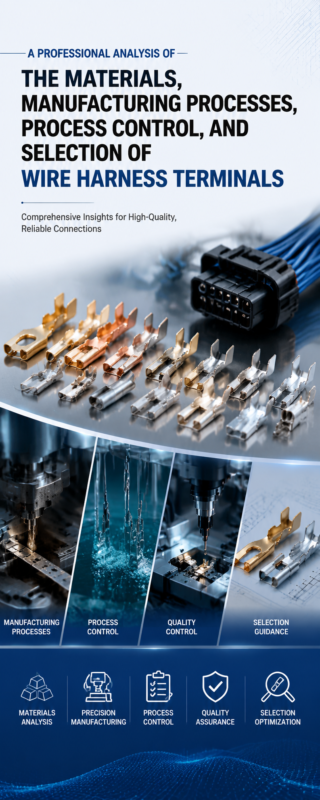
Terminals, housings, seals, secondary locks, and mating connectors form one connector system. Review wire harness terminal materials and crimping và JST connector selection guide for component-level examples.
Harnesses can be grouped by application, construction, electrical function, and operating environment. These categories overlap, and a single assembly may fit several groups.
| Grouping | Examples | Primary design concern |
|---|---|---|
| Đơn đăng ký | Automotive, industrial, medical equipment, aerospace, appliance, marine | Industry-specific interfaces, environment, documentation and validation |
| Construction | Open bundle, taped, braided, conduit-protected, jacketed, molded, overmolded | Routing, protection, flexibility, service access and manufacturing method |
| Electrical function | Power, signal, data, RF, hybrid power-and-data | Current, voltage drop, impedance, shielding, heat and noise coupling |
| Motion | Fixed, occasional movement, cable carrier, torsion, door or hinge | Bend radius, flex construction, strain relief and motion profile |
| Environment | Dry enclosure, outdoor, wet, high heat, chemical, high vibration | Materials, sealing, protection, mounting and test conditions |
| Development stage | Prototype, pre-production, production, replacement or service harness | Revision control, approvals, tooling, test coverage and change management |
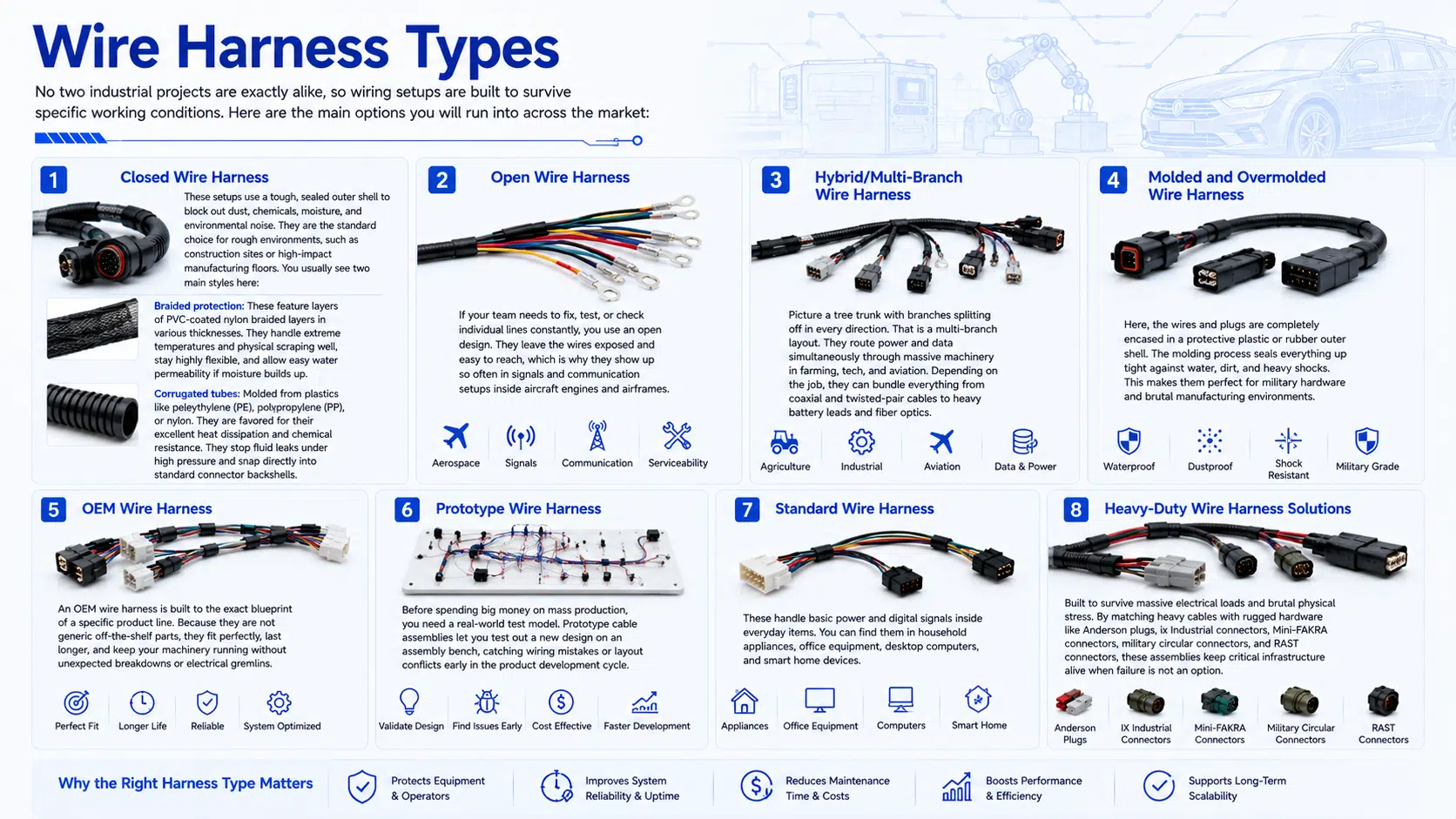
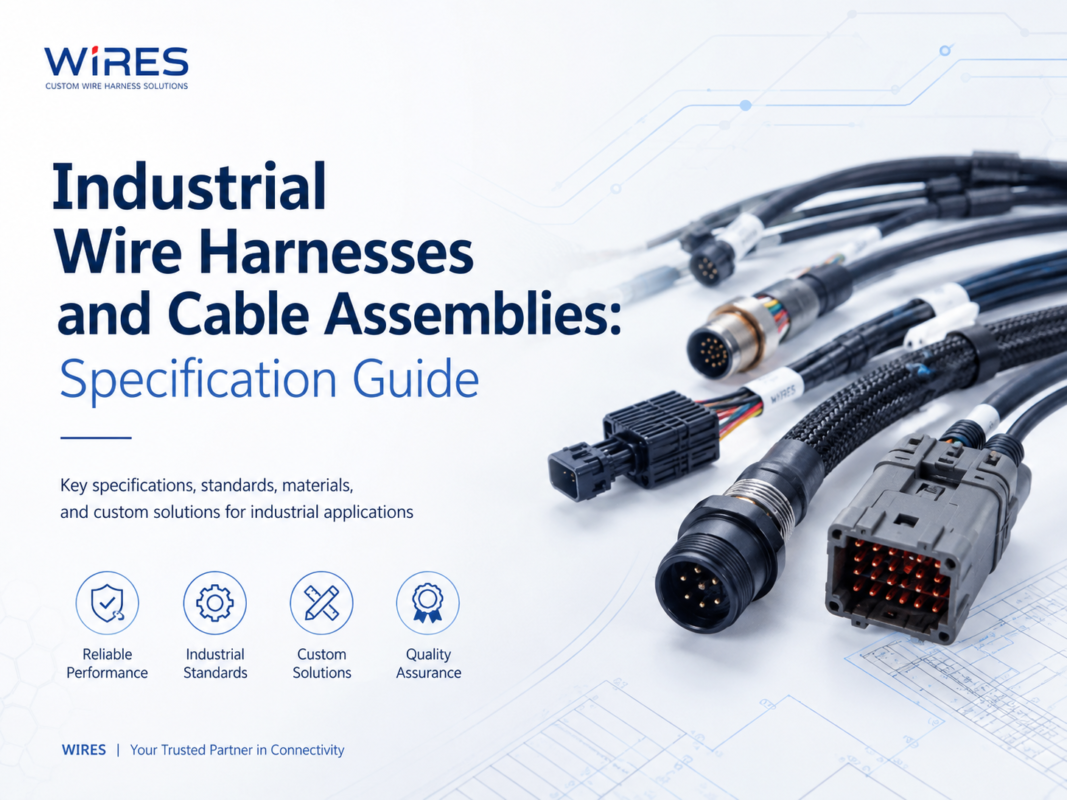
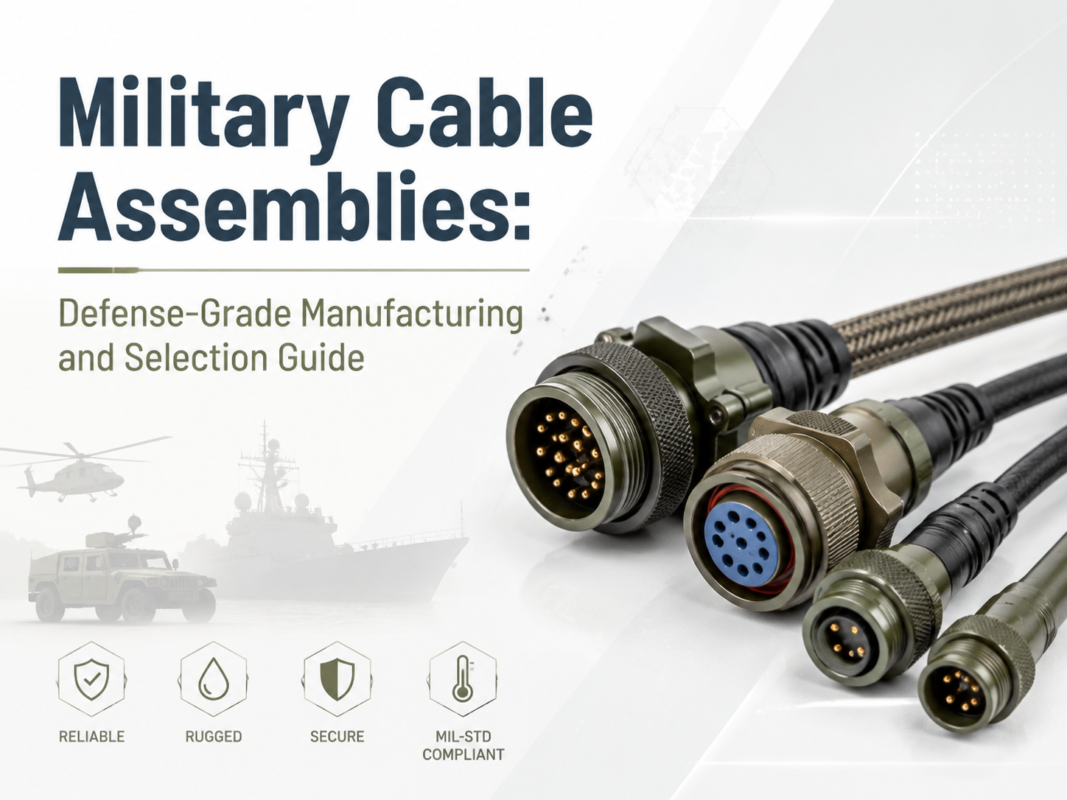
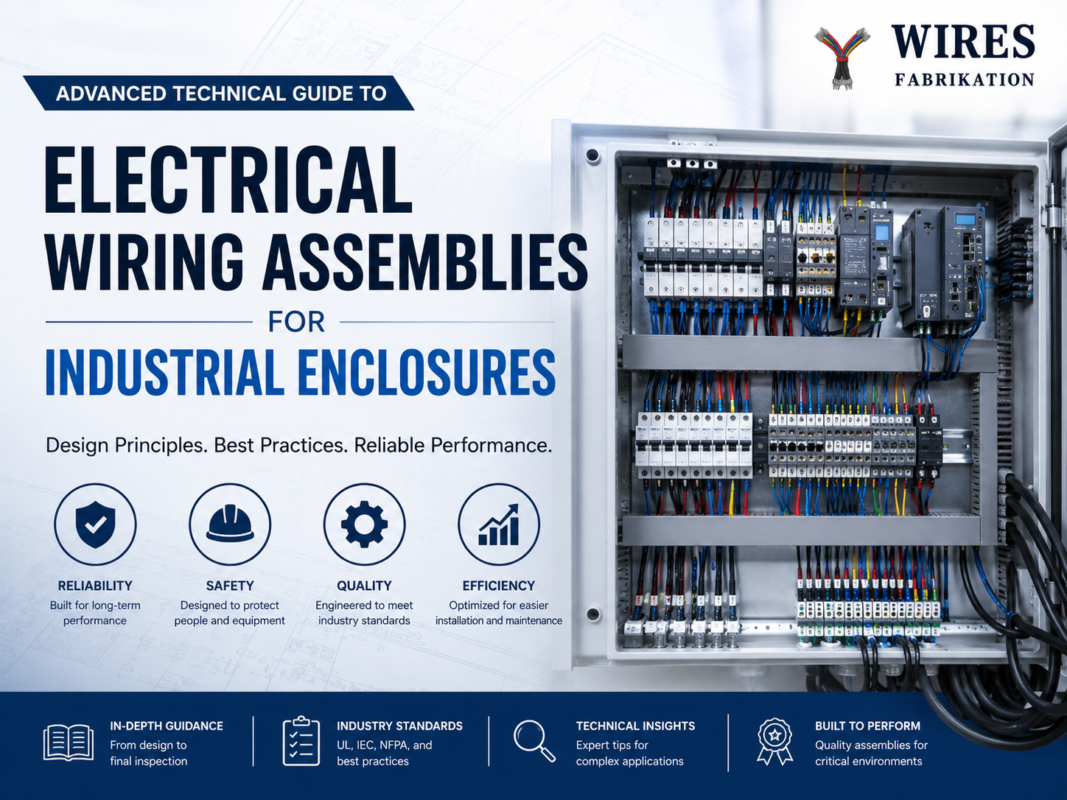
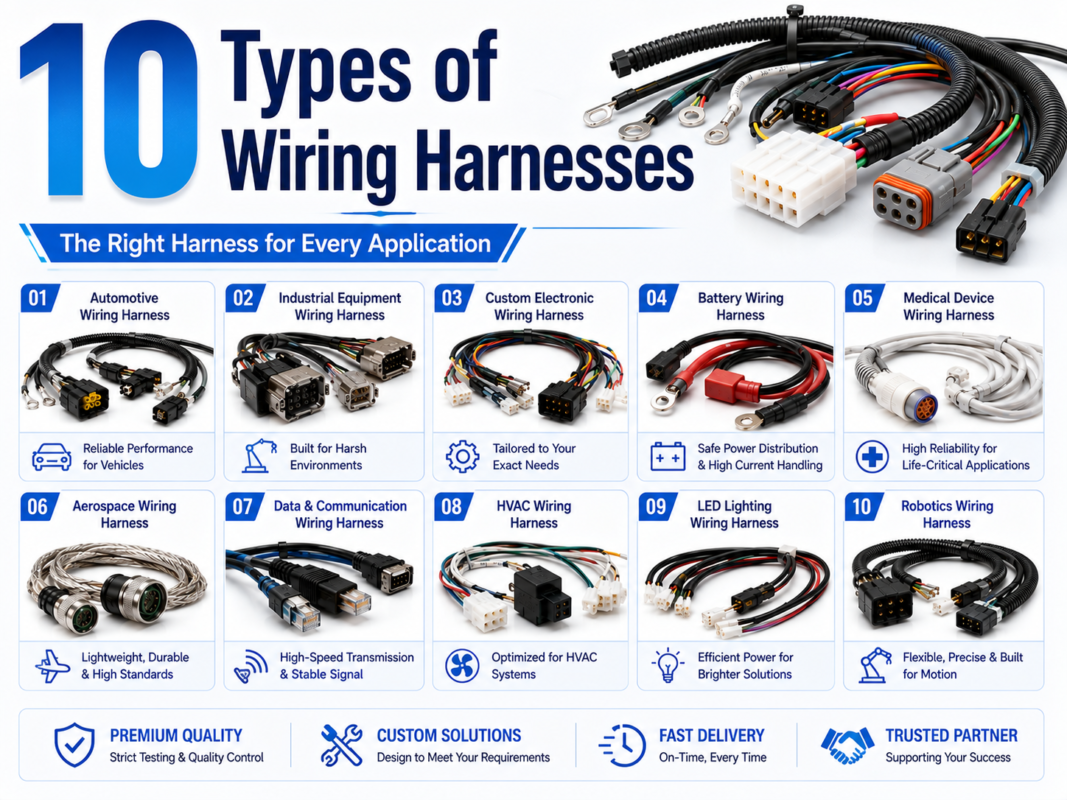
For a detailed application comparison, use the separate guide to 10 common types of wiring harnesses. Examples of focused designs include bộ dây điện công nghiệp, car electrical wiring harnesses, và military cable assemblies.
Harnesses connect power supplies, PLCs, sensors, drives, motors, safety devices, control panels, and machine modules. Fixed cabinet wiring and moving robotic cables need different materials and routing. Connector locking, oil exposure, vibration, and service access are common design inputs.
Vehicle harnesses distribute power and data among electronic control units, sensors, lights, actuators, infotainment, battery systems, and safety equipment. Requirements depend on the vehicle platform, voltage class, zone, OEM specification, and market.
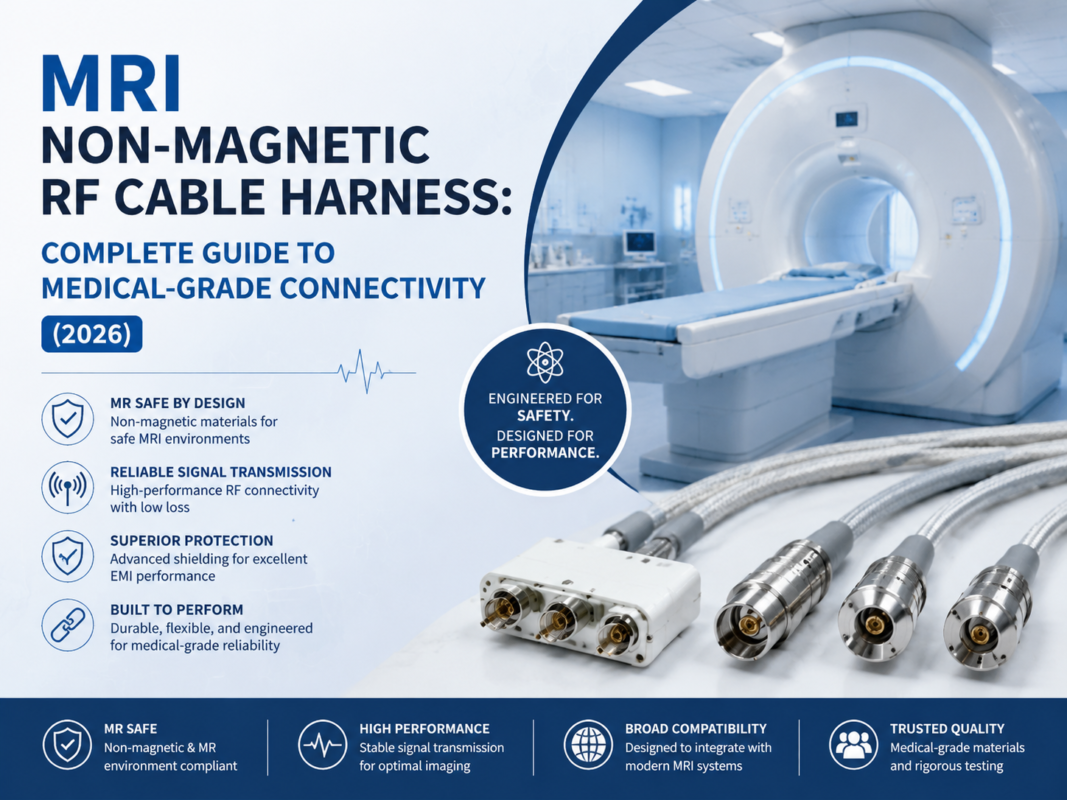
Medical-equipment harnesses may prioritize signal integrity, compact routing, traceability, repeated cleaning, low magnetic content, or specific material restrictions. Device risk analysis and approved specifications determine what applies; the word “medical” alone is not a cable rating.
These harnesses may require weight control, shielding, routing separation, lacing or clamping, identification, configuration management, and project-specific qualification. Standards references must be separated from supplier certification claims.
Harnesses connect controls, motors, heaters, displays, switches, sensors, and power inputs. Repeatable assembly, polarization, flame requirements, hot-zone routing, edge protection, and serviceability are common considerations.
Outdoor harnesses can face UV, moisture, salt, temperature cycling, fluids, and limited service access. Tinned conductors, seals, overmolds, heat shrink, and protective jackets may be appropriate, but they must be selected from the actual exposure and test requirements.
A structured custom wire harness development process helps resolve missing inputs before production. For a new or uncertain design, a Bộ cáp mẫu can verify fit, routing, pinout, connector access, installation, and basic function.
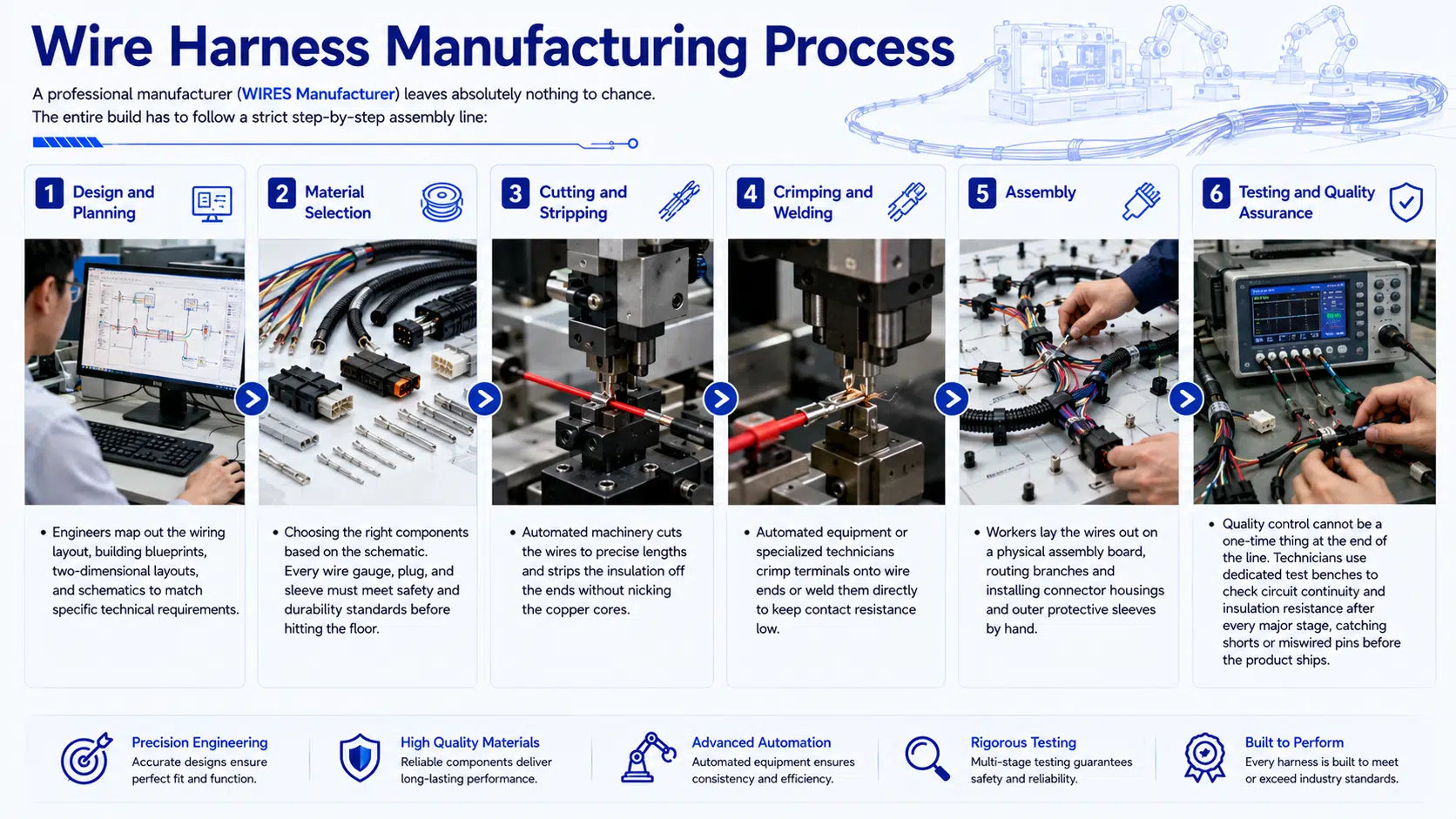
Not every factory or project uses the same process sequence or test coverage. Automated cutting, crimp-force monitoring, ultrasonic welding, overmolding, electrical testing, or traceability should be claimed only when the specific equipment, process, and project evidence are available.
| Kiểm soát | Purpose | Source of acceptance criteria |
|---|---|---|
| Material and part-number verification | Prevents unapproved wire, terminal, housing, seal, or protection substitutions | Approved BOM, datasheets and customer specification |
| Strip and crimp inspection | Checks conductor preparation and terminal formation | Terminal supplier data, approved tooling study and applicable standard |
| Terminal retention or pull test | Verifies mechanical termination performance | Wire-terminal combination and governing specification |
| Continuity and pinout | Finds open circuits, shorts and miswires | Approved schematic, cavity table and test program |
| Resistance or voltage-drop test | Evaluates current path when required | Circuit specification and defined test conditions |
| Insulation or dielectric test | Checks electrical isolation where applicable | Product specification, voltage class and component limits |
| Dimensional and visual inspection | Verifies branch layout, orientation, labels, protection and workmanship | Drawing, approved sample and workmanship criteria |
| Environmental qualification | Evaluates temperature, vibration, fluids, ingress, flexing or EMC as required | Project qualification plan and applicable standards |
No universal crimp height, pull force, resistance, test voltage, sampling rate, or high-voltage test applies to every harness. Limits must come from the exact components, application, customer specification, and governing standard. See the wire harness quality-control guide for a deeper inspection framework.
A standards reference is not proof that WIRES is certified to it or that every product complies. Request the exact certificate and scope for a management-system claim, component evidence for a material claim, and a test report for a finished-assembly performance claim.
| Potential benefit | Condition required |
|---|---|
| Faster equipment assembly | Connectors, branches, clips, labels and installation sequence are designed for the product |
| Controlled routing and protection | Materials and mounting match the actual heat, abrasion, movement and fluids |
| Reduced installation errors | Pinout, keying, color, labels, test coverage and documentation are controlled |
| Easier service and replacement | Harness divisions, connectors, access and spare-part strategy support maintenance |
| Repeatable production | Drawing, BOM, tooling, process, inspection and change control remain consistent |
A harness can also add weight, cost, package volume, connectors, and potential failure points. Good design uses only the branches, interfaces, protection, and service breaks that the system requires.
Một OEM wiring harness should be based on controlled product requirements rather than assumptions from a damaged sample. Related custom cable assembly options can help identify whether the project is best treated as a branched harness, a jacketed cable assembly, or a combination.
A wire harness is a planned group of electrical wires, cables, terminals, connectors, and protection assembled to route power and signals through a product. It is built to a specific pinout, layout, environment, and test requirement.
The terms overlap, but a wire harness often uses multiple discrete wires and branches for internal routing, while a cable assembly is often based on a jacketed cable with terminated connectors. The actual drawing and construction are more important than the name.
Common components include wires, cables, terminals, connector housings, seals, splices, shielding, tapes, sleeving, conduit, grommets, boots, overmolds, clips, labels, and circuit-protection components where specified.
Wire size is selected from voltage, continuous and peak current, allowable voltage drop, circuit length, ambient temperature, bundling, duty cycle, insulation class, connector limits, and protective-device coordination.
Common causes include abrasion, poor routing, heat, fluids, moisture, vibration, conductor fatigue, connector damage, incorrect terminals, weak crimps, corrosion, overload, unapproved repairs, and design changes that were not revalidated.
No. Sealing should match the installation. A dry enclosure may not need a sealed connector, while an outdoor, underbody, marine, or washdown application may require a defined ingress test. IP ratings apply to tested configurations and conditions.
Review engineering inputs, material control, tooling, workmanship criteria, inspection methods, test evidence, traceability, change control, and how nonconforming product is handled. Do not rely only on marketing claims or a generic certificate logo.
Send the schematic, drawing, connector and terminal part numbers, branch layout, environment, applicable standards, tests, and quantities through the WIRES contact page. Complete inputs allow a project-specific review without inventing certifications, performance limits, minimum order quantities, or delivery promises.
 English English
 Vietnamese
 Indonesian
 Arabic
 Spanish