



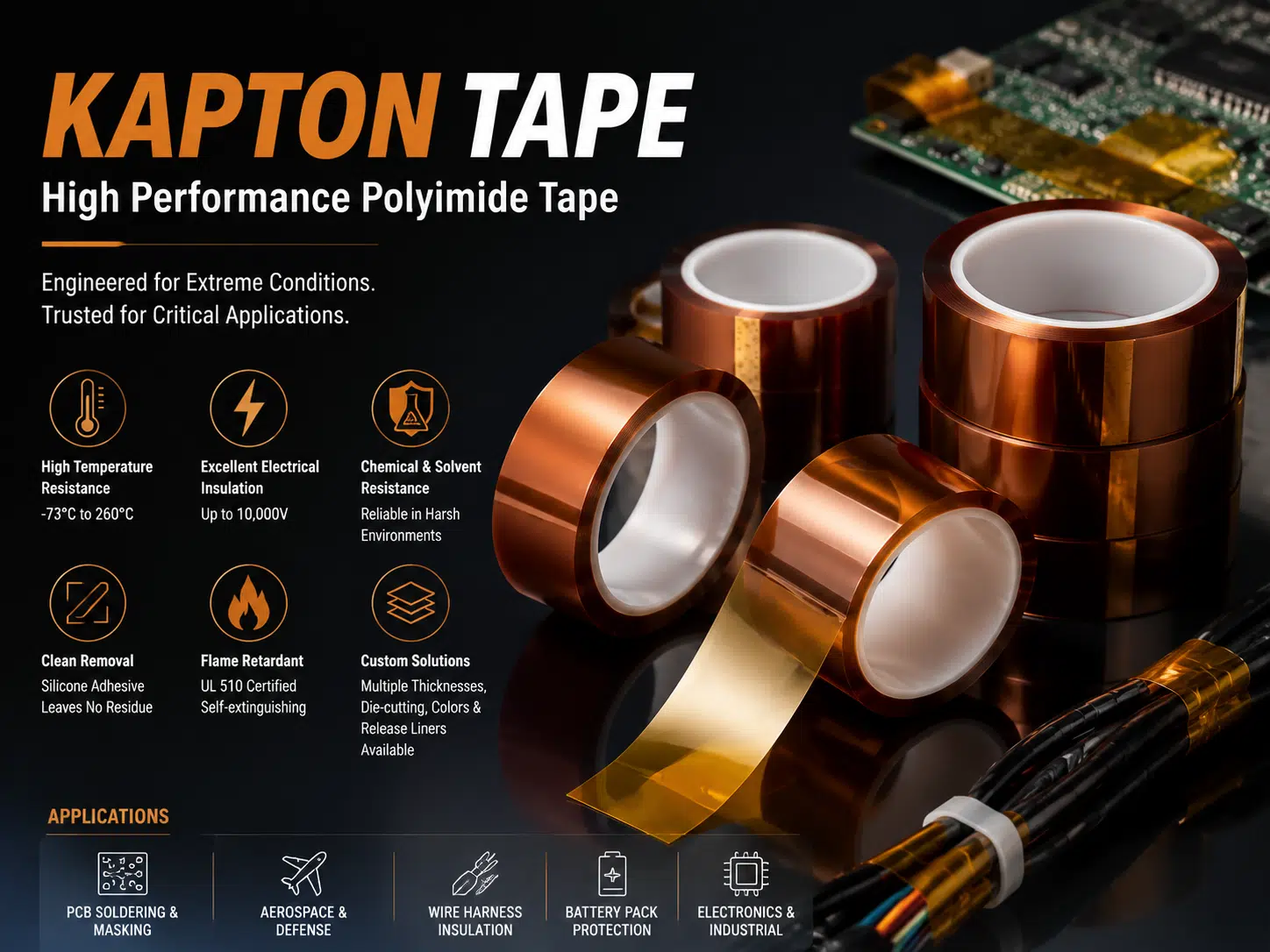
Kapton tape is commonly used as a name for pressure-sensitive tape made with polyimide film. It is selected for electrical insulation, high-temperature processing, masking, and compact assemblies because polyimide film can provide useful thermal, dielectric, and dimensional properties. The final performance depends on the exact film, adhesive, thickness, construction, surface, temperature profile, dwell time, and test method. Buyers should verify the supplier data sheet rather than treating every amber polyimide tape as equivalent.
Trademark note: Kapton is a DuPont trademark for specific polyimide film products. In general purchasing language, “Kapton tape” is often used broadly for polyimide film tape. If branded Kapton film is required, specify the film manufacturer and grade and request supporting documentation.
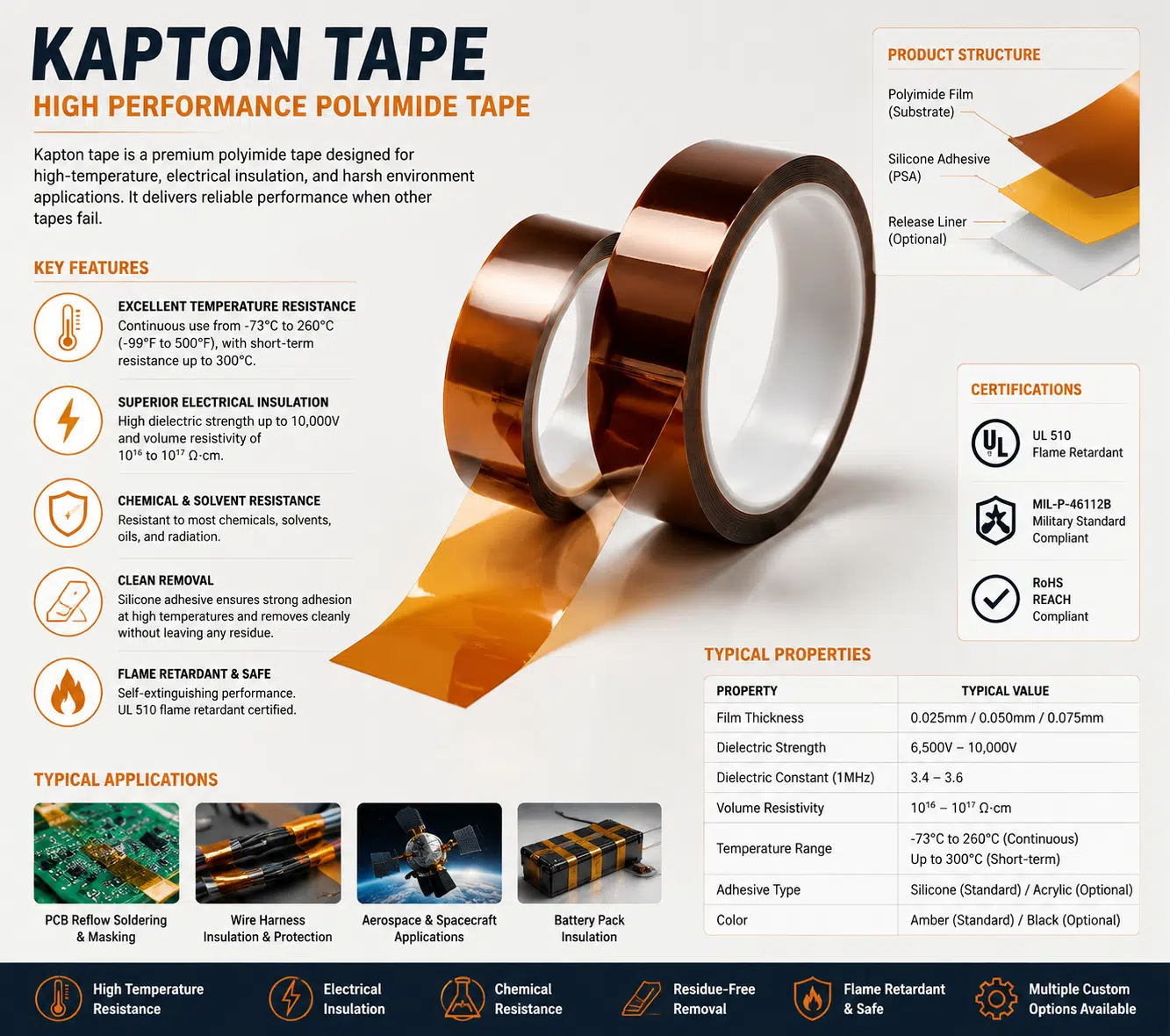
A typical polyimide tape combines a thin polyimide film with a pressure-sensitive adhesive. Silicone adhesive is common for elevated-temperature processing, while acrylic and other adhesive systems are available for different bonding, residue, cost, and environmental requirements. Some applications use unsupported polyimide film or custom laminates rather than ordinary single-sided tape.
| Construction element | What it controls | What to verify |
|---|---|---|
| Polyimide film | Dielectric behavior, dimensional stability, flexibility, color, and thermal response | Film manufacturer, grade, nominal thickness, and relevant test data |
| Adhesive | Bonding, removability, residue, temperature exposure, and surface compatibility | Chemistry, coat weight, adhesion method, dwell conditions, and aging data |
| Primer or treatment | Adhesive anchorage and surface behavior | Supplier construction and process compatibility |
| Release liner | Handling, die-cut conversion, and automated placement | Liner material, release level, slit accuracy, and packaging |
| Finished tape | Total thickness, width, roll length, winding, and edge quality | Actual finished dimensions and tolerances on the purchase specification |
Within a wire harness assembly, polyimide tape may provide localized insulation, temporary holding, abrasion separation, identification, or process masking. It is not automatically a substitute for a jacket, conduit, strain relief, fuse, mechanical clamp, or environmental seal.
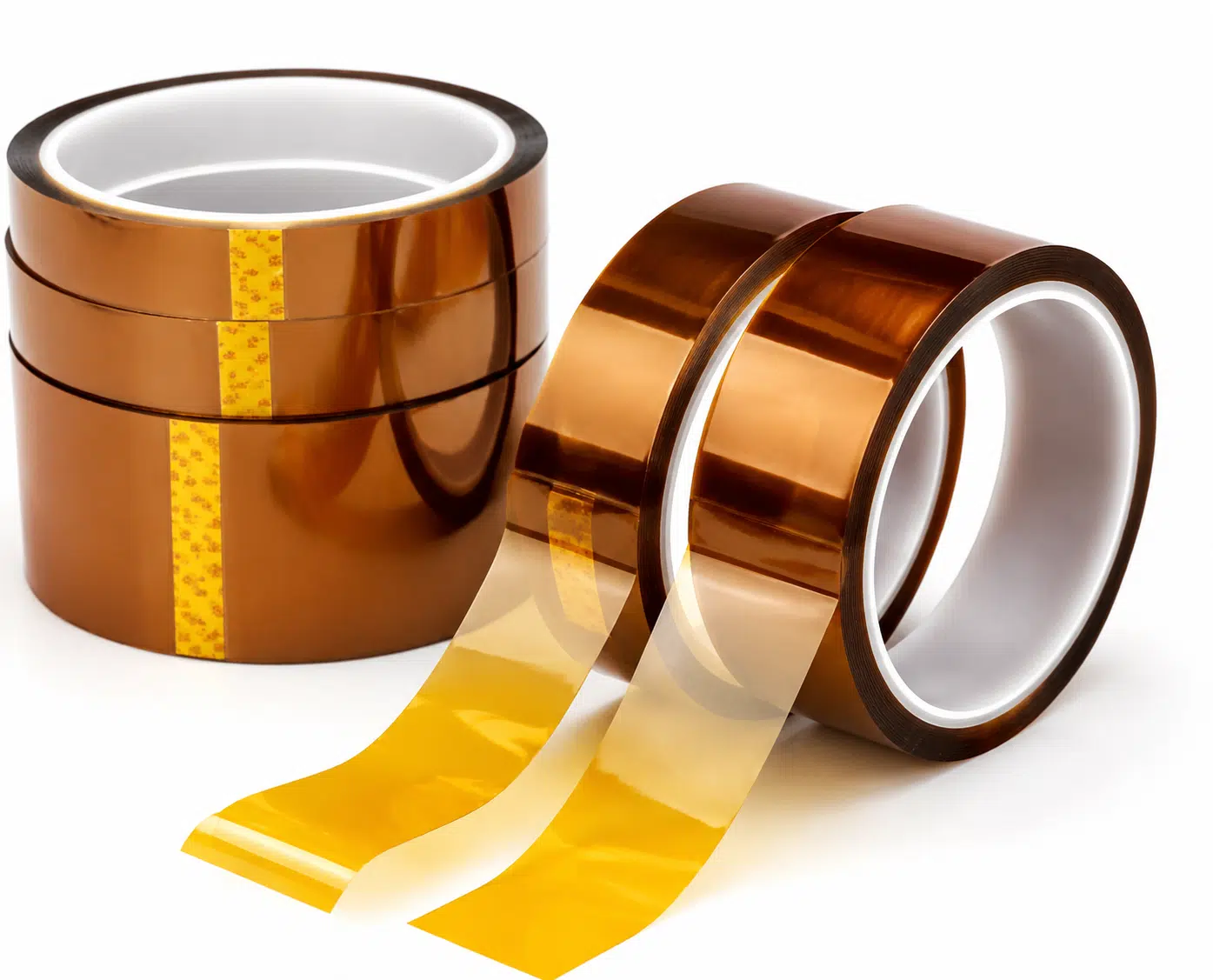
Polyimide film is known for retaining useful properties across a broad temperature range, but the tape rating is not the same as the film rating. Adhesive chemistry, exposure time, air or vacuum conditions, mechanical load, substrate, and repeated thermal cycling can determine the practical limit.
Do not use a single maximum-temperature number without its test condition. For solder masking, record the oven or solder profile, peak exposure, time above the process threshold, number of cycles, cooling method, and required removal window. For continuous service, use the long-term rating provided for the complete tape construction.
Dielectric strength and insulation resistance depend on film thickness, defects, humidity, temperature, electrode geometry, test method, and aging. A catalog value is not a universal safe working voltage. The application design must include creepage, clearance, edge coverage, overlap, puncture risk, contamination, and the consequences of a single-layer defect.
When tape is used near wire harness terminals, keep adhesive and film out of mating and crimp zones unless the connector design specifically permits them.
Thin polyimide film can fit into compact electronic assemblies and follow moderate contours. It can still wrinkle, bridge a sharp step, split at a nicked edge, or lift under cable spring force. Rounded edges, controlled tension, adequate overlap, and compatible bend geometry improve repeatability.
Resistance to a solvent does not guarantee that the adhesive will remain bonded or remove cleanly. Flux, cleaners, oils, plasticizers, mold-release agents, and surface coatings can affect adhesion and residue. Test the complete process on the actual substrate.
Flame performance and low-outgassing status are product-specific. If a project references UL 510, ASTM E595, an aerospace specification, or another standard, request the exact product designation, report, recognition file, revision, test method, and applicable limits. A generic material description does not prove compliance, and a standards reference is not a WIRES certification claim.
| Application | Why polyimide tape is considered | Main selection risks |
|---|---|---|
| PCB solder masking | Thin masking around pads, contacts, and components during a defined thermal process | Residue, adhesive transfer, edge lift, flux exposure, and removal timing |
| Electrical insulation | Localized dielectric barrier in compact assemblies | Puncture, edge coverage, voltage design, contamination, and layer consistency |
| Wire harness wrapping | Spot insulation, branch holding, abrasion separation, or process support | Flagging, unwind force, flexibility, overlap, and long-term adhesive aging |
| Motor and transformer work | Coil, lead, layer, or terminal insulation in a specified insulation system | Thermal class, varnish compatibility, mechanical stress, and system approval |
| Battery and power assemblies | Cell-edge, tab, busbar, sensor, or localized insulation | Fault energy, compression, electrolyte exposure, heat, and assembly movement |
| Aerospace and vacuum equipment | Lightweight insulation or masking where documented materials are required | Outgassing, traceability, flammability, thermal cycling, and program specifications |
| Die-cut components | Repeatable shapes for automated placement or tight clearances | Tooling tolerance, liner release, orientation, edge quality, and placement control |
For industrial cable routing and cabinet work, compare tape with the protection, separation, and grounding requirements in the industrial enclosure wiring guide. For vehicle applications, use the temperature, fluid, abrasion, and service requirements defined for the exact zone in the automotive harness design guide.
State whether the tape is for temporary masking, permanent insulation, harness wrapping, surface protection, bonding, labeling, or die-cut placement. One product rarely optimizes every function.
Separate process peak, dwell time, continuous operating temperature, thermal cycling, and storage conditions. Include whether the exposure occurs in air, inert gas, vacuum, oil, or another environment.
Nominal polyimide film thicknesses around 25, 50, and 75 micrometers are commonly offered, but availability and tolerance are supplier-specific. Total tape thickness also includes adhesive and any liner. Thicker film can improve handling and puncture resistance, while thinner film can fit tighter spaces; neither choice guarantees the required dielectric performance without test data.
| Adhesive option | Typical reason to consider it | Verification needed |
|---|---|---|
| Silicone pressure-sensitive adhesive | Elevated-temperature processing and bonding to selected low-energy surfaces | Residue, migration, contamination sensitivity, adhesion after aging, and process limits |
| Acrylic pressure-sensitive adhesive | Alternative bonding, aging, cost, or handling requirements | Temperature profile, removability, chemical exposure, and substrate compatibility |
| No pressure-sensitive adhesive | Unsupported film, formed insulation, slot liner, or custom lamination | Mechanical retention, forming, bonding process, and assembly design |
Specify the operating voltage, transient conditions, insulation architecture, required test method, minimum result, layer count, overlap, and environmental state. For a power path, review the complete conductor, connector, insulation, and validation design in the custom power cable guide.
Identify the substrate, surface energy, finish, cleanliness, application pressure, dwell time, temperature, and removal condition. “Residue-free” should be treated as a test result for a defined process, not a universal tape property.
Define roll width, roll length, core, winding direction, splice policy, edge quality, color, opacity, print, liner, die-cut geometry, tab, kiss-cut depth, packaging, and automated-placement requirements.
| Evidence | What it should identify | Why it matters |
|---|---|---|
| Technical data sheet | Exact product code, construction, nominal dimensions, ratings, test methods, and revision | Prevents values from one tape being applied to another |
| Material declaration | Film, adhesive, restricted-substance, and regulatory information as required | Supports customer and market requirements |
| Certificate of conformance | Purchase order, lot, product, and declared specification | Supports traceability but does not replace qualification testing |
| Electrical test data | Method, specimen thickness, conditioning, electrodes, and results | Makes dielectric data interpretable |
| Adhesion and residue data | Substrate, peel method, dwell, temperature, aging, and removal condition | Connects the result to the real process |
| Flame or recognition file | Exact recognized product and applicable category or construction | Avoids unsupported certification claims |
| Outgassing report | Exact material, adhesive, lot or product, method, conditioning, and limits | Supports vacuum or aerospace screening when required |
| Sample validation record | Actual substrate, process profile, inspection criteria, and pass/fail result | Confirms application compatibility before release |
Programs involving defense or aerospace equipment may impose additional traceability, material, workmanship, and change-control requirements. Use the project documents and the cautious standards approach described in the military cable assembly guide.
| Failure | Likely contributors | Corrective action |
|---|---|---|
| Tape lifts during heating | Contaminated surface, insufficient application pressure, incompatible adhesive, cable spring force, or excessive thermal exposure | Clean and characterize the surface, review geometry, and test the full thermal profile |
| Adhesive residue remains | Long dwell, high temperature, aged tape, incompatible substrate, or unsuitable adhesive | Set an approved removal window and qualify the adhesive on the real surface |
| Film tears at an edge | Nicked slit edge, sharp corner, high tension, or mechanical movement | Improve edge quality, radius the contact point, and reduce installation stress |
| Electrical test fails | Puncture, insufficient overlap, contamination, wrong thickness, void, or unsuitable test assumptions | Inspect the insulation architecture and repeat testing under the specified conditions |
| Die-cut part misplaces | Liner release, orientation, static, tolerance, or placement-control problem | Review converting tolerances, presentation, tooling, and application method |
| Harness becomes too stiff | Excessive layers, wrong width, high wrap tension, or unsuitable film thickness | Use localized protection, revise overlap, or select another protection method |
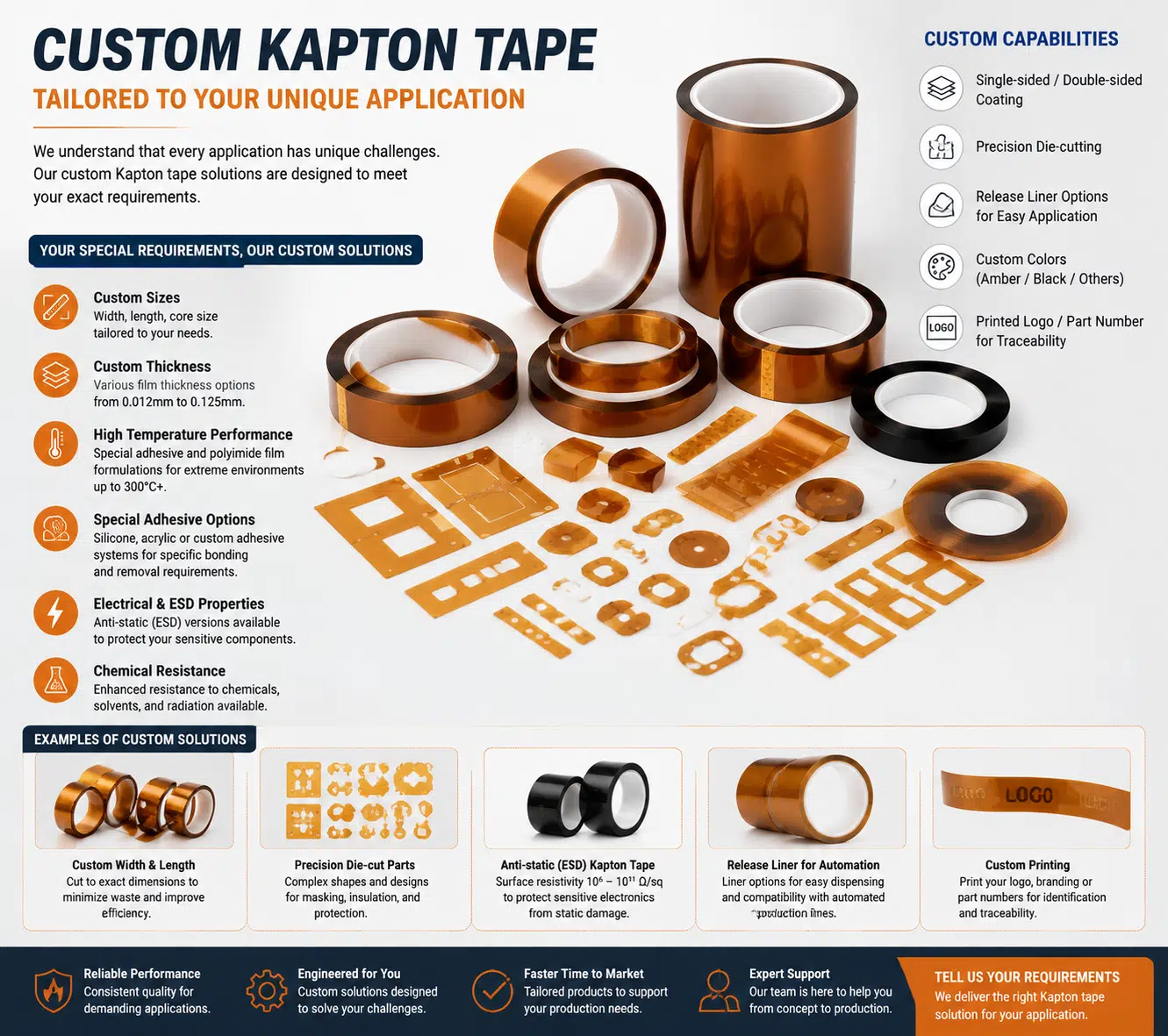
Customization can include slit rolls, narrow widths, tabs, discs, rings, windows, multi-layer laminates, single- or double-sided adhesive, release liners, printed identification, anti-static constructions, opaque films, and parts supplied for automated placement. Each feature must be linked to a drawing, tolerance, material code, and inspection plan.
When polyimide tape is incorporated into a custom harness, define it on the bill of materials and assembly drawing just like the wire, connector, terminal, and protection components. The wire harness and cable assembly specification guide provides a practical structure for those requirements.
Review relevant custom cable and harness products, then use the customized development process to organize material codes, drawings, and application conditions. A prototype cable assembly can confirm fit, handling, routing, and process compatibility before release. Final inspection should follow a documented wire harness quality plan.
Kapton is a trademark for specific DuPont polyimide films. Many sellers use the term broadly for amber polyimide tape, but the actual film and adhesive may be different. Verify the product identity when branded material is required.
There is no universal tape temperature. The film, adhesive, thickness, exposure time, atmosphere, substrate, and test method all affect the rating. Use the complete tape data sheet and validate the actual process profile.
No. Residue depends on adhesive chemistry, surface, cleanliness, temperature, dwell time, aging, pressure, and removal method. Qualify removal on the real component.
It can be suitable for specified localized insulation or wrapping, but the design must consider puncture, overlap, flexing, abrasion, fluids, heat, adhesive aging, and service conditions. It does not replace required mechanical protection or circuit protection. For the broader conductor, termination, routing, and protection package, review the custom wire harness design process.
Choose film and total thickness from the dielectric, puncture, flexibility, fit, and handling requirements. Common nominal film sizes are only starting points; verify the exact supplier construction and tolerance.
No. Color does not prove flame or outgassing performance. Request the exact product report, recognition, method, revision, and limits required by the project.
Die-cut parts can improve placement repeatability, cycle time, edge geometry, and automation when the design is stable. They require controlled tooling, tolerances, liner release, orientation, packaging, and change management.
A reliable Kapton tape selection starts by identifying the actual polyimide film, adhesive, construction, application, and evidence. Define the temperature profile, electrical and mechanical duties, substrate, removal condition, required standards, converting details, and validation plan before approving a material.
For a project-specific review, send the tape function, substrate, temperature profile, dimensions, drawing, required reports, and harness application through the WIRES contact page.
 English English
 Vietnamese
 Indonesian
 Arabic
 Spanish


