

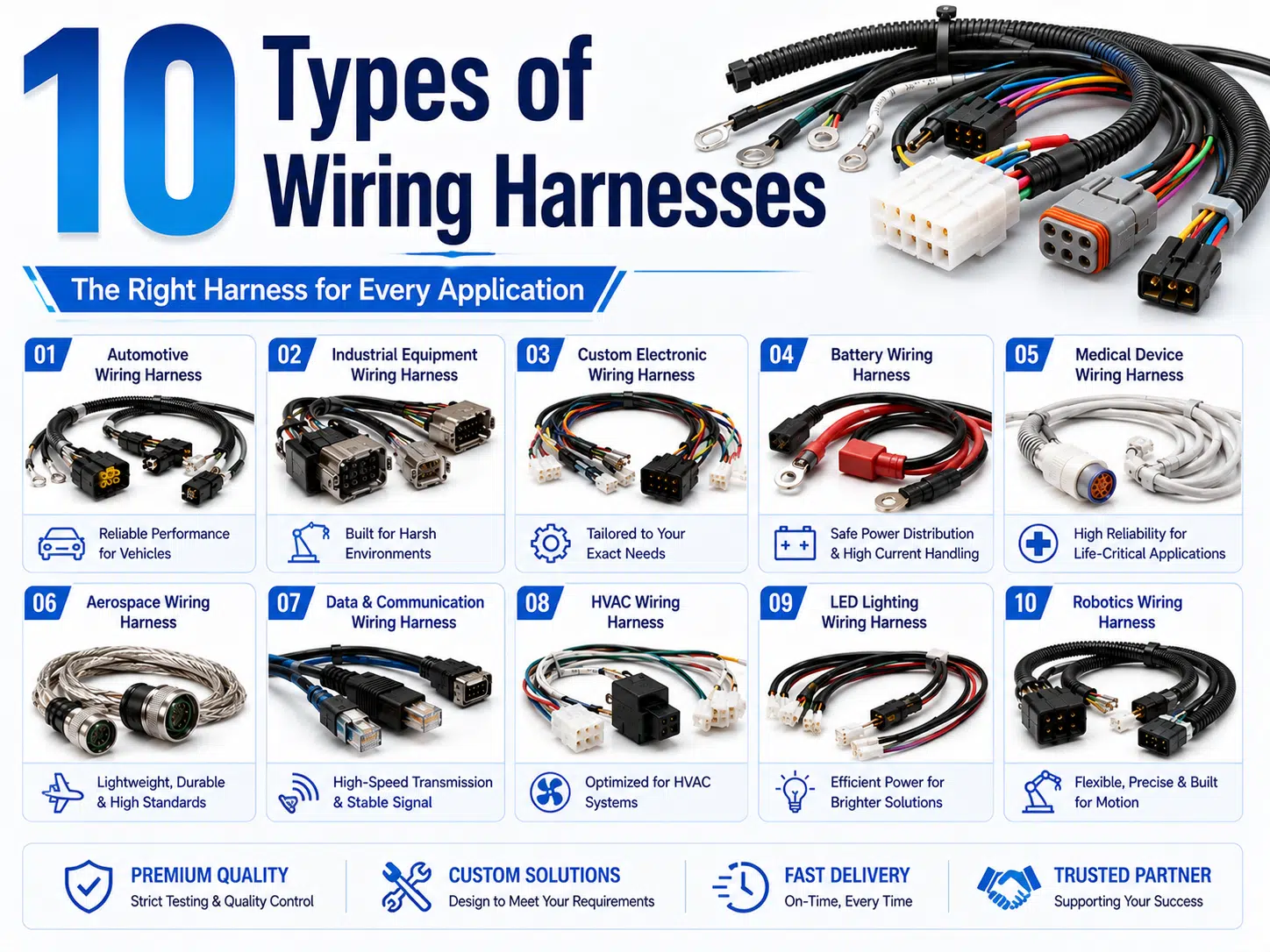
Wire harnesses are commonly grouped by application, operating environment, electrical function, and construction. The right type is not chosen by a name alone. It must match the circuit load, connector system, routing space, movement, temperature, fluids, electromagnetic environment, applicable standards, and validation plan.
This guide compares 10 common types of wiring harnesses used in vehicles, medical equipment, industrial machinery, data systems, energy equipment, aerospace systems, appliances, marine equipment, security systems, and heavy machinery. For a basic definition before comparing categories, see what a wire harness is and how it is built.
The following categories are practical sourcing and engineering groupings, not a single universal industry taxonomy. A real assembly may belong to more than one category. For example, a robotic medical-device harness may need both continuous-motion construction and medical-equipment documentation.
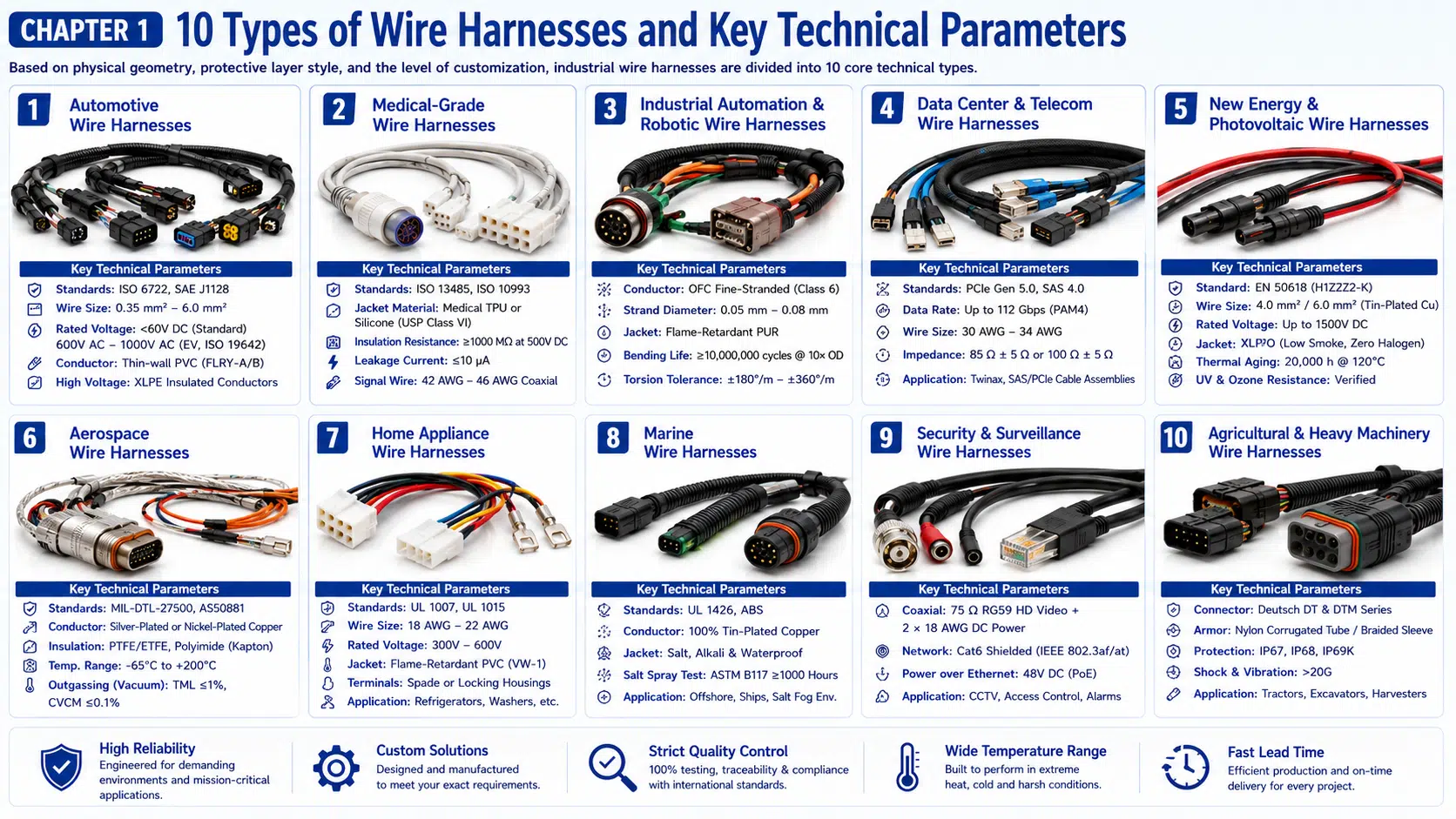
| Harness type | Typical applications | Primary design priorities | Requirements to confirm |
|---|---|---|---|
| Automotive | Body, chassis, powertrain, battery, sensors, lighting | Routing, vibration, temperature, sealing, serviceability | Vehicle OEM specification, voltage class, connector series, ISO or SAE requirements |
| Medical equipment | Imaging, monitoring, diagnostics, laboratory equipment | Signal integrity, cleanability, traceability, low magnetic or biocompatible materials where required | Device risk file, patient-contact status, IEC/ISO requirements, cleaning method |
| Industrial automation and robotics | Control cabinets, machines, robots, cable carriers | Flexing, abrasion, oil resistance, EMC, maintainable routing | Motion profile, bend radius, acceleration, fluid exposure, machine standard |
| Data center and telecom | Servers, storage, network equipment, internal interconnects | Controlled impedance, insertion loss, crosstalk, airflow, connector retention | Protocol generation, channel length, connector specification, test fixture |
| Renewable energy and storage | Solar arrays, inverters, battery racks, wind equipment | Voltage rating, UV exposure, temperature, flame behavior, polarity control | System voltage, installation location, cable standard, overcurrent protection |
| Aerospace and defense | Aircraft, unmanned systems, ground equipment, mission electronics | Weight, vibration, shielding, temperature, identification, configuration control | Contract drawing, applicable military/aerospace specification, qualification and acceptance tests |
| Home appliance | Refrigerators, washers, HVAC controls, cooking equipment | Cost-effective assembly, heat zones, locking, flame requirements, assembly speed | Appliance safety standard, recognized wire style, temperature and voltage rating |
| Marine | Boats, deck equipment, navigation, pumps, offshore systems | Moisture, salt, corrosion, sealing, strain relief | Vessel rules, tinned conductor requirement, ingress rating, salt-fog test plan |
| Security and surveillance | Cameras, access control, alarms, sensors | Power delivery, signal type, shielding, installation distance, field termination | PoE class or DC load, cable category, fire rating, local installation code |
| Agricultural and heavy machinery | Harvesters, excavators, mining and construction equipment | Dust, mud, water, vibration, impact, repairability | Connector sealing, harness protection, routing clamps, environmental test severity |
Automotive harnesses distribute power and data among electronic control units, sensors, lighting, actuators, infotainment systems, and safety-related circuits. They may be divided into body, dashboard, door, chassis, engine, battery, and high-voltage sub-harnesses.
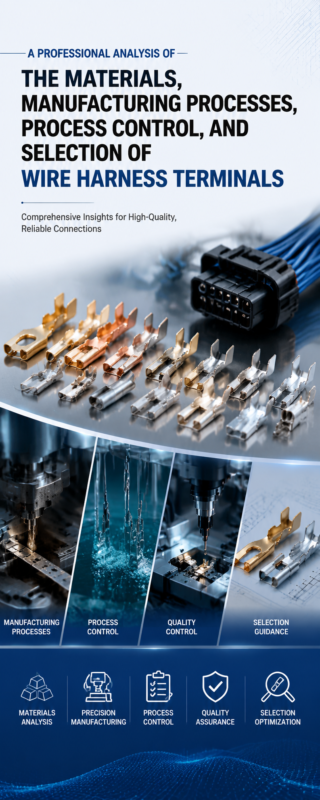
Wire type, temperature class, abrasion protection, sealing, and connector retention must follow the vehicle manufacturer’s specification. ISO 6722, SAE J1128, and the ISO 19642 series may be relevant, but applicability depends on the vehicle platform, voltage class, market, and contract. A supplier should never treat one wire specification as suitable for every vehicle circuit. See the related guide to wire harness terminals and crimp selection.
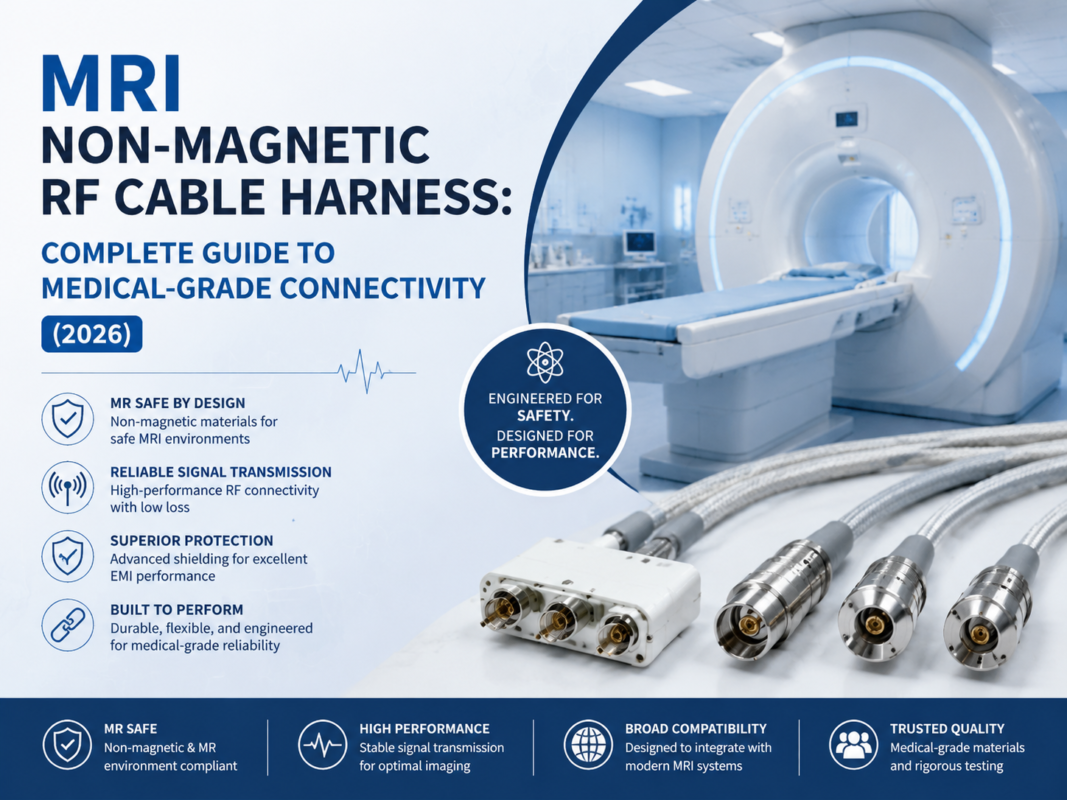
Medical-equipment harnesses connect sensors, motors, imaging modules, displays, power supplies, and control electronics. The design may prioritize low-level signal integrity, repeated cleaning, compact routing, traceability, or non-magnetic materials.
ISO 13485 is a quality-management standard for medical-device organizations; it is not a universal material rating for a cable. ISO 10993 applies when biological evaluation is required for patient-contacting materials. Electrical limits, leakage-current requirements, cleaning resistance, and material restrictions must come from the device risk analysis and approved specifications. For a specialized application example, review the MRI non-magnetic RF cable harness design guide.
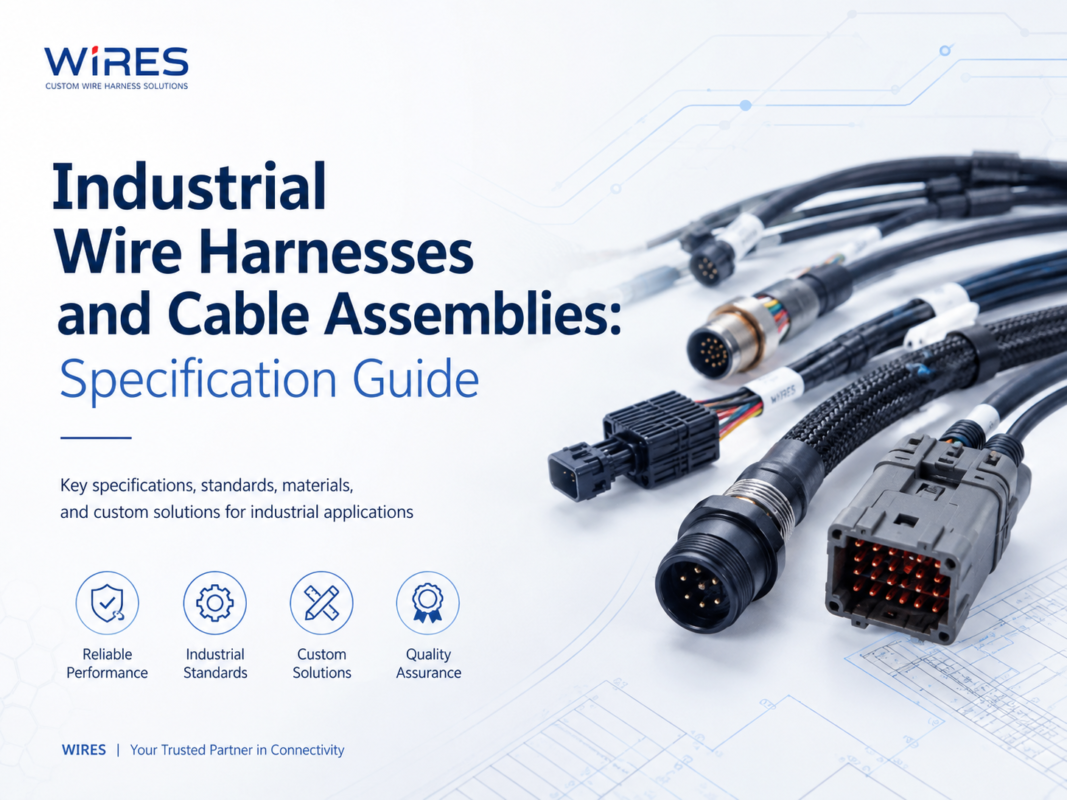
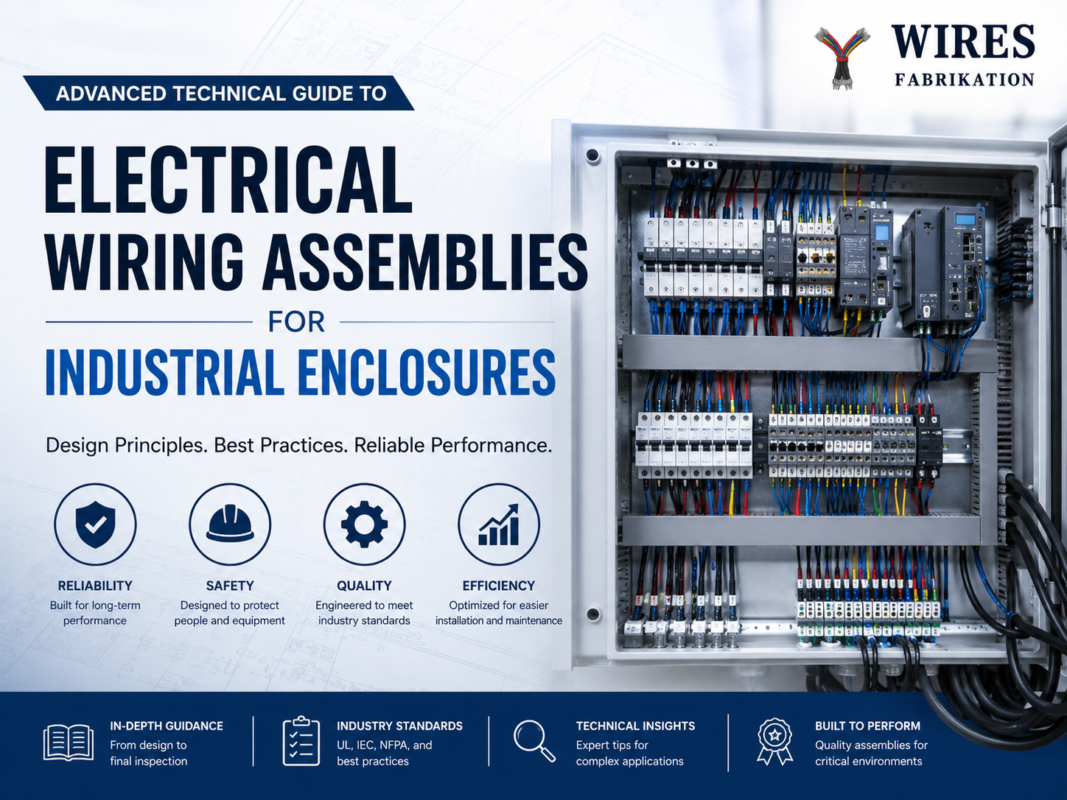
Industrial harnesses connect PLCs, drives, motors, sensors, safety devices, control panels, and machine modules. Fixed-routing harnesses and continuous-motion cables require different constructions. A cable that works inside a stationary enclosure may fail quickly in a cable carrier or twisting robot joint.
For moving systems, define the bend radius, travel distance, speed, acceleration, torsion, cycle target, and installation method. Flex-life values are only meaningful when the supplier’s test method matches the actual motion profile. PUR, TPE, PVC, and other jacket materials each have tradeoffs in abrasion, oil resistance, flame behavior, flexibility, and cost. Buyers evaluating this category can also review industrial wire harness manufacturing considerations and industrial enclosure wiring.
Data and telecom assemblies include internal server cables, storage interconnects, high-speed twinax, power distribution leads, backplane connections, and network equipment harnesses. Their performance depends on the complete channel: conductor geometry, dielectric, shielding, pair consistency, connector launch, length, routing, and test fixture.
Do not select these assemblies by connector appearance alone. Confirm the protocol generation, lane count, impedance requirement, insertion-loss budget, crosstalk limits, mating connector, and validation method. A connector that physically fits may still be electrically unsuitable for the required data rate.
Solar, wind, inverter, and battery-storage harnesses may operate at elevated DC voltage and in outdoor environments. Common design concerns include UV exposure, temperature cycling, moisture, flame behavior, creepage and clearance, polarity control, connector compatibility, and field-service procedures.
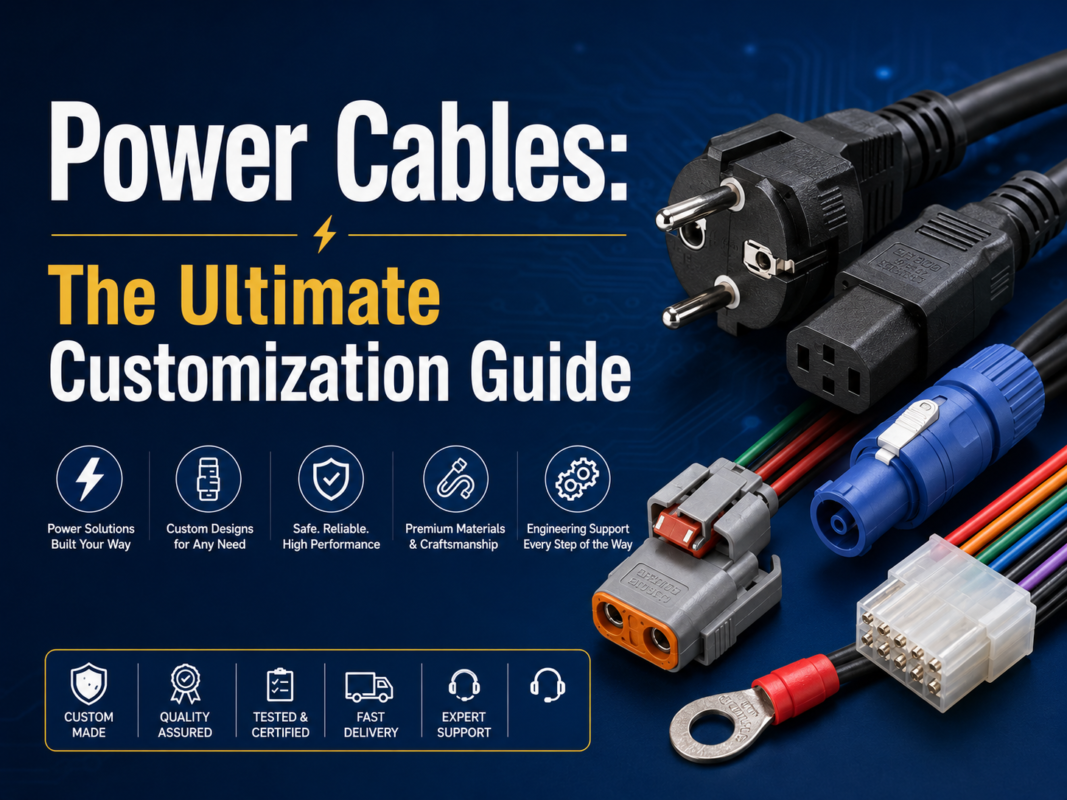
EN 50618 and IEC 62930 are examples of standards used for photovoltaic cable, but a compliant cable does not automatically make the complete harness compliant. Connectors, terminations, routing, overcurrent protection, and system installation must also be evaluated. When power delivery is the main design problem, use the custom power cable specification guide.
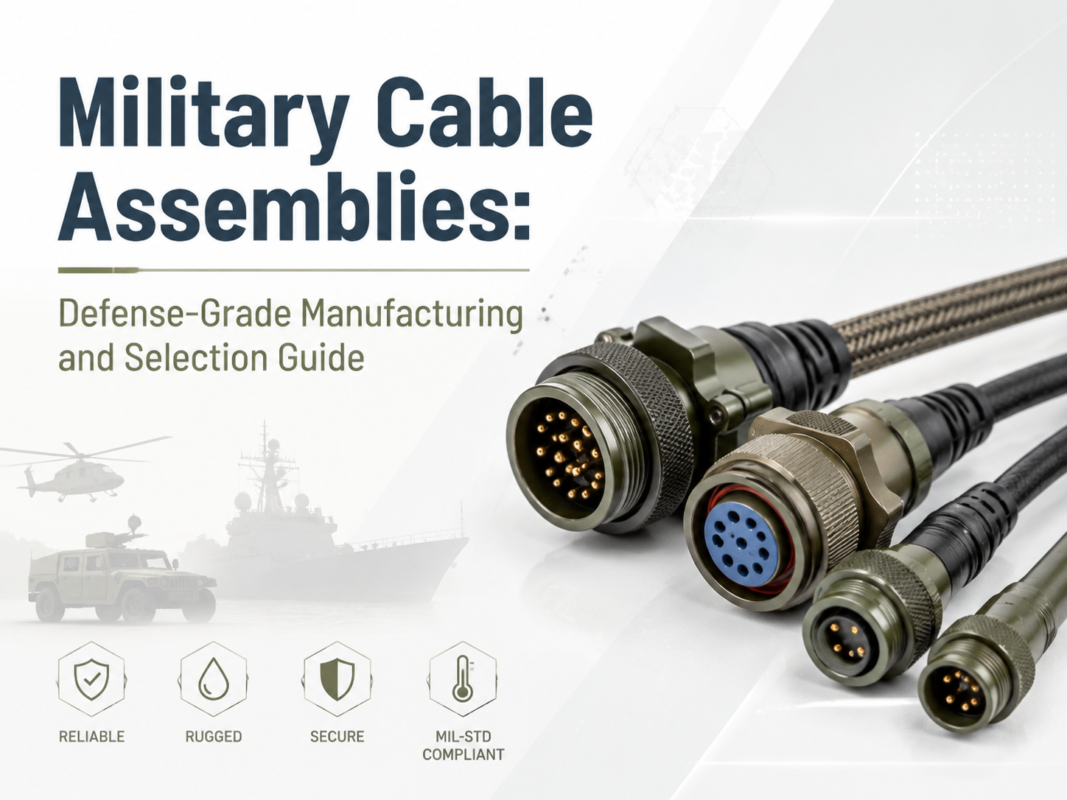
Aerospace and defense harnesses may require low weight, controlled routing, shielding, lacing or clamping, fire and smoke performance, vibration resistance, identification, and strict configuration control. Materials and processes are selected from the approved drawing and contract requirements.
AS50881 and MIL-DTL-27500 may be referenced on applicable programs, but a standards reference must not be presented as a WIRES certification claim. The required revision, slash sheet, component approvals, workmanship class, qualification tests, and acceptance tests should be stated in the purchase documentation. For a deeper requirements framework, see the military cable assembly design and standards guide.
Appliance harnesses connect mains input, heaters, compressors, motors, controls, displays, switches, and sensors. They are designed for repeatable assembly and safe routing around hot surfaces, moving parts, and sheet-metal edges.
UL wire styles such as UL 1007 or UL 1015 may be specified for particular circuits, but the correct style must be verified by its current recognition information, temperature rating, voltage rating, conductor size, and end-product standard. Terminal locking, polarization, strain relief, routing clips, and operator error prevention are often as important as the wire itself.
Marine harnesses face moisture, condensation, salt, corrosion, vibration, and limited service access. Tinned copper conductors, sealed connectors, adhesive-lined heat shrink, corrosion-resistant hardware, and drip-aware routing may be appropriate depending on the installation.
UL 1426 or vessel-classification requirements may apply to specific projects. The buyer should define whether the harness is in a protected cabin, machinery space, deck location, or continuously wet area. IP ratings apply to a tested enclosure or connection under specified conditions; they should not be used as a blanket claim for an entire harness. See waterproof cable assembly design options.
Security harnesses combine power, video, network data, alarm contacts, access-control signals, or sensor connections. Common formats include coax-plus-power assemblies, Ethernet-based links, and multi-conductor control cables.
For Power over Ethernet, confirm the applicable IEEE 802.3 implementation, power class, conductor temperature rise, channel length, connector system, and cable category. For analog video or low-level sensors, shielding and grounding should be designed around the equipment interfaces rather than applied as a generic rule.
Harnesses for construction, mining, and agricultural equipment need protection against vibration, impact, mud, dust, pressure washing, fluids, and field repairs. Sealed connector families, corrugated conduit, braided sleeving, abrasion-resistant tape, boots, grommets, and robust clamping are common design tools.
Connector IP ratings, vibration limits, and chemical resistance must be verified for the exact connector series, accessory set, wire range, seal condition, and test method. Connector family names alone do not prove environmental performance.
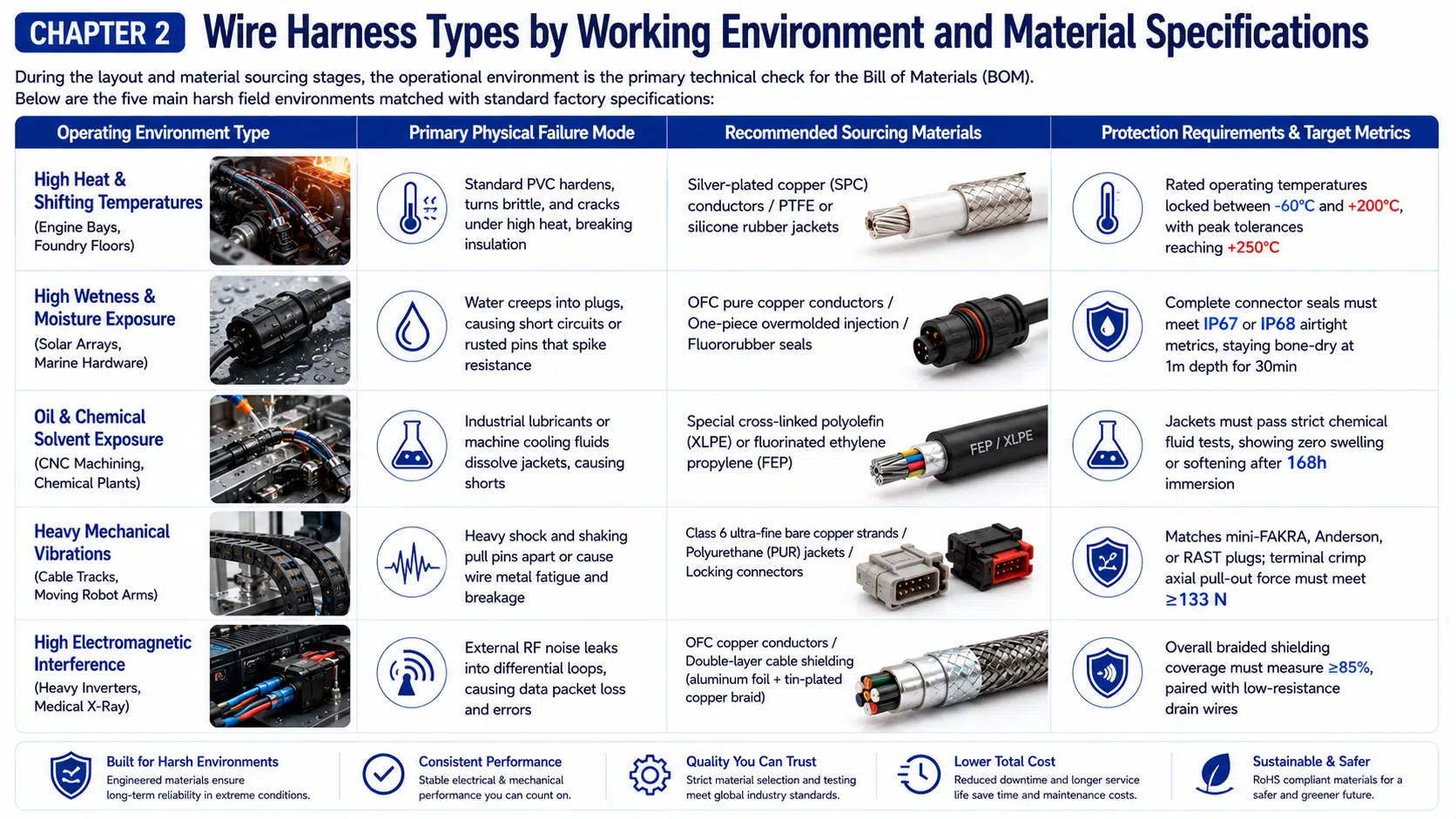
Operating environment should be translated into measurable requirements before the bill of materials is released. The table below shows the engineering questions that matter more than generic labels such as “heavy duty” or “industrial grade.”
| Environment | Typical failure mode | Design options to evaluate | Evidence to request |
|---|---|---|---|
| Heat and temperature cycling | Insulation hardening, seal damage, contact relaxation | Temperature-rated wire, heat barriers, suitable terminals and seals | Component datasheets and project temperature profile |
| Water and humidity | Corrosion, insulation leakage, capillary ingress | Sealed connectors, overmolding, heat shrink, drainage and drip loops | Defined ingress test, mated condition, duration, depth or pressure |
| Oil and chemicals | Swelling, cracking, softening, label loss | Compatible jacket, seals, tubing, markers and adhesives | Named fluids, concentration, temperature, exposure time and acceptance criteria |
| Repeated movement | Conductor fatigue, shield breakage, connector strain | Fine-stranded conductors, flex jacket, controlled bend radius, strain relief | Motion profile and representative flex or torsion test |
| Electromagnetic interference | Data errors, unstable sensor readings, emissions failure | Twisted pairs, foil or braid, controlled termination, physical separation | Interface specification, EMC test plan and grounding architecture |
Power harnesses carry energy to motors, heaters, actuators, batteries, and electronic modules. Conductor size should be calculated from continuous and peak current, allowable voltage drop, ambient temperature, bundling, duty cycle, protection device, and installation method. “Use a thicker wire” is not a complete design rule.
Signal harnesses carry sensor, control, communication, RF, or video signals. Pair geometry, shielding, return path, connector transition, routing, and termination can affect performance. The drawing should identify which circuits require controlled impedance, twisting, coaxial construction, drain wires, or separation from noisy power circuits.
Hybrid harnesses place power, low-level signals, data pairs, coax, fiber, pneumatic lines, or other services in one assembly. They simplify installation but require careful breakout design and separation. Each circuit should be assessed for heat, noise coupling, bend behavior, service access, and connector pin assignment.
A structured custom wire harness development process helps turn these inputs into a manufacturable drawing and inspection plan. For early builds, a prototype cable assembly can reveal routing, fit, pinout, and assembly problems before production release.
Do not copy a universal crimp height, pull force, insulation resistance, or high-voltage test value from another harness. These limits depend on the approved terminal-wire combination and governing specification. The wire harness quality-control guide explains how design evidence and production checks work together.
| Mistake | Why it causes problems | Better approach |
|---|---|---|
| Choosing only by harness category | Two automotive or industrial harnesses can have completely different environments and loads | Specify circuits, interfaces, routing, environment, and tests |
| Assuming a connector is sealed by appearance | Sealing depends on the exact housing, seals, plugs, wire range, mating condition, and assembly | Verify the complete connector system and test condition |
| Using a generic flex-cycle claim | Cycle life changes with bend radius, speed, travel, torsion, temperature, and installation | Match the test profile to the real motion |
| Treating a standard reference as certification | A standard can be applicable without the supplier or product being certified to it | Request the exact certificate, scope, revision, or test report when required |
| Changing terminals without revalidation | Tooling, crimp geometry, plating, retention, and mating performance may change | Control approved alternatives and repeat relevant validation |
Common types include automotive, medical equipment, industrial and robotic, data and telecom, renewable-energy, aerospace and defense, appliance, marine, security, and heavy-machinery harnesses. These are practical application groups; one harness can fit several categories.
A wire harness usually organizes multiple discrete wires and branches for routing inside a system. A cable assembly is often more integrated and may use a common jacket, overmold, shield, or rugged outer protection. The terms overlap, so the construction drawing matters more than the label. See the detailed wire harness vs. cable assembly comparison.
There is no single best type. Select materials and protection from the actual hazards: temperature, water, chemicals, abrasion, vibration, movement, UV, dust, and electromagnetic interference. Then define a test that reproduces the relevant exposure.
No. An IP rating applies to the tested product configuration and conditions. Wire seals, unused cavities, backshells, cable entries, splices, overmolds, mating condition, assembly quality, and capillary paths can still affect the complete harness.
Provide the drawing or sample, schematic, annual and batch quantities, connector and terminal part numbers, wire specifications, branch dimensions, labels, environmental conditions, applicable standards, test requirements, and approved alternatives. Missing inputs should be listed as open engineering questions rather than replaced with assumptions.
Yes, but a hybrid harness needs circuit separation, thermal review, shielding and grounding decisions, connector pin planning, and validation for noise coupling. The design should be tested in the intended equipment configuration.
The harness category is only the starting point. A reliable specification connects the electrical design, mechanical layout, materials, connector system, manufacturing controls, and validation evidence. Send your drawing, BOM, connector part numbers, operating environment, and test requirements through the WIRES contact page for a project-specific review.
 English English
 Vietnamese
 Indonesian
 Arabic
 Spanish