

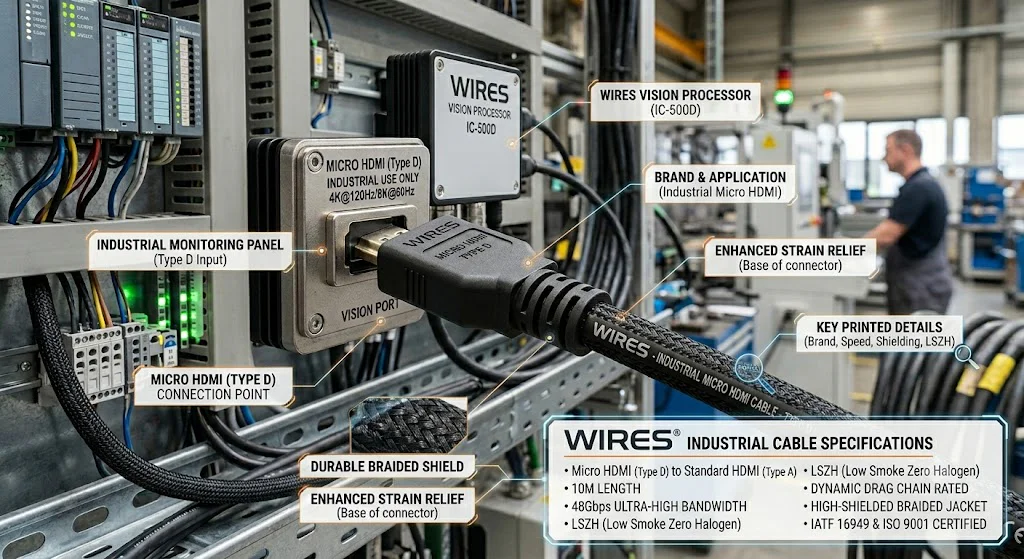
As precision instruments and automation gear shift toward downsizing, Micro HDMI cables are becoming the essential hardware link for high-speed, HD video transmission.
The Micro HDMI interface (or HDMI Type D) is the smallest connector size in the standard HDMI family. It keeps the full 19-pin signal layout within about half the space of a standard Type A port, specifically built for high-density hardware designs.
Consumer-grade Micro HDMI cables are mostly used for slim tablets or cameras; their jackets are fragile and lack high-density shielding, making them unfit for high-frequency mechanical stress. Industrial and medical-grade Micro HDMI cables, however, are fully reinforced in material choice and internal structure to specifically handle vibrations, oil stains, and heavy electromagnetic interference (EMI).
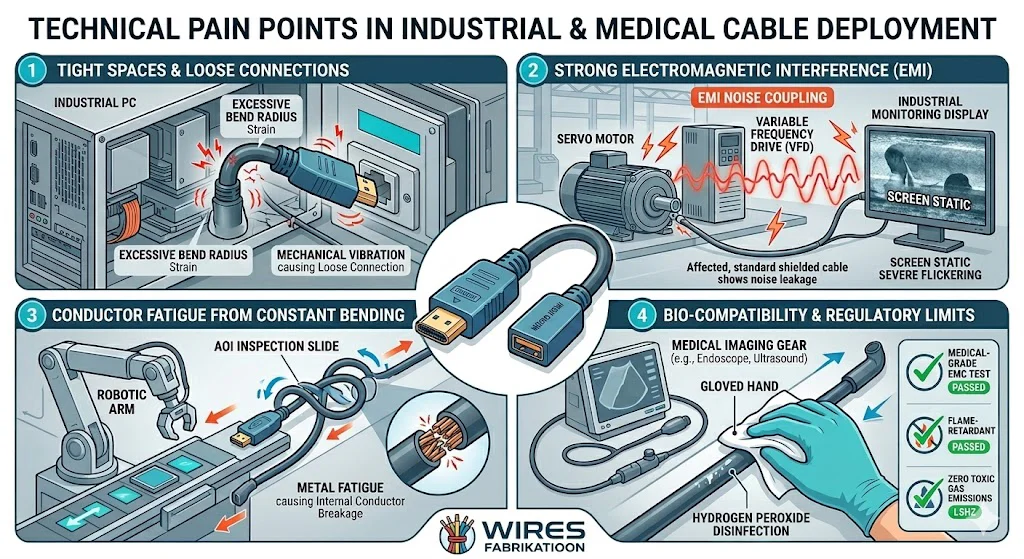
When regular consumer cables are deployed on factory lines or in sterile medical rooms, they often trigger a string of electrical failures early on. Understanding these real-world pain points is key to ensuring overall signal integrity.
1. Tight Spaces & Loose Connections: Micro industrial PC cases leave very little room. Regular cables have a bend radius that is simply too large, which puts stress on the plug and snaps the wire right at the connector root. Because the Micro HDMI interface is so small, normal machine vibrations can shake it loose if there is no external locking mechanism.
2. Strong Electromagnetic Interference (EMI): Factory floors are packed with servo motors, variable frequency drives (VFDs), and switching power supplies that blast out high-frequency spatial radiation. When noise leaks into a video cable that lacks specialized shielding, it causes screen static, severe flickering, or total signal drops.
3. Conductor Fatigue from Constant Bending: Robotic arms and automated optical inspection (AOI) slides move millions of times during production. Under continuous pulling and twisting, standard copper wires suffer from metal fatigue and break internally, causing machine downtime.
4. Strict Bio-compatibility & Regulatory Limits: Video lines for medical imaging gear (like endoscopes and ultrasound devices) must withstand frequent wipe-downs with hydrogen peroxide or high-concentration alcohol. At the same time, the cables must pass tough medical-grade electromagnetic compatibility (EMC) tests, remain flame-retardant, and release zero toxic gases when overheating.
To tackle challenges in space limits, dynamic bending, EMI interference, and high-bandwidth transmission, WIRES provides four main categories of custom Micro HDMI cable solutions to fit everything from fixed setups to high-flex moving parts.
Passive Micro Copper Cables: Built with high-purity oxygen-free copper (OFC) or silver-plated copper as the transmission media, delivering ultra-low signal lag. Due to physical attenuation, we recommend keeping the effective transmission distance within 3 meters to guarantee a stable 4K@60Hz feed.
AOC Active Optical Cables: These feature micro photoelectric conversion modules built inside the connectors, using multi-mode fiber to transmit high-speed TMDS signals. The light signal suffers almost zero loss over a distance, and since fiber doesn’t carry electricity, it is naturally immune to all spatial EMI, allowing for clean runs over 30 meters long.
| Architecture Type | Core Transmission Media | Recommended Distance | Core Technical Advantage |
| Passive Micro Copper Cable | High-purity oxygen-free copper (OFC) / Silver-plated copper | Within 3 meters | Ultra-low signal lag, highly budget-friendly, classic reliable build |
| AOC Active Optical Cable | Multi-mode optical fiber + Micro converter chips | 30 meters and up | Zero signal loss over long distances, 100% immune to spatial EMI |
Static Cables: Designed for tight spots inside machine enclosures where cables stay put. The internal wires are packed tightly together to save maximum physical space.
High-Flex Drag Chain Cables: Built specifically for robotic arms and moving guide tracks. They feature multiple strands of ultra-fine alloy wires twisted together and are wrapped in a low-friction Teflon (PTFE) insulation layer. They handle 5 to 10 million continuous bending cycles without breaking under a specific bend radius.
Standard Friction Lock: Relies on the built-in metal leaf springs of the Type D plug to stay in place. Best for steady gear that doesn’t shake or get unplugged often.
Custom Screw Lock: Features single or dual precision locking screws (like M2 or M2.5) built right into the molded plug shell. It bolts tightly onto industrial camera housings so it can never shake loose.
Push-Pull Quick Release: Uses a mechanical push-pull lock setup that secures with a simple push and releases when you pull back the outer sleeve. This is the top choice for handheld medical probes.
Industrial Oil-Res Resistant Polyurethane (PUR/TPU): This jacket is incredibly tough. It resists cutting oils, heavy scraping, and UV rays, making it perfect for messy factory floors.
Medical Low-Smoke Zero-Halogen (Medical LSZH / Silicone): Fully certified for bio-compatibility. The outer skin is smooth, easy to clean, stands up to chemical disinfectant wipes, and releases zero toxic smoke while staying flame-retardant.
Before finalizing your cable design, you must align the technical builds with global HDMI specifications to ensure full compatibility with your hardware chips.
Type A (Standard HDMI): Around 13.9mm wide. The standard choice for regular industrial PCs, monitors, and server racks.
Type C (Mini HDMI): Around 10.42mm wide. Commonly found on industrial tablets and DSLR cameras.
Type D (Micro HDMI): Only 6.4mm wide. The definitive choice for tight embedded boards, micro-cameras, and space-saving hardware designs.
Type E (Automotive HDMI): Comes with a specialized heavy-duty shell to stop vehicle vibrations from breaking the link.
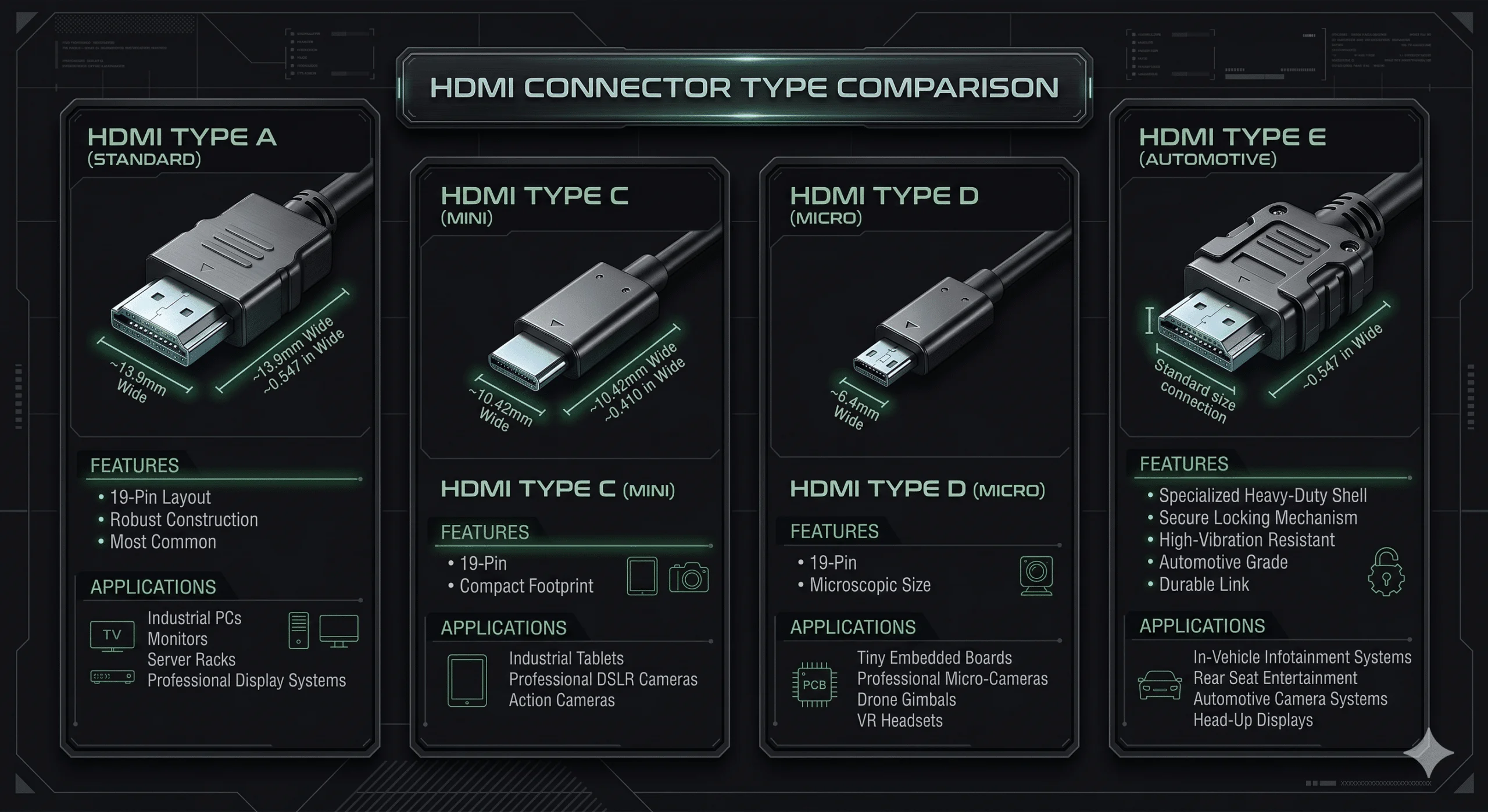
| Connector Type | Physical Width (Approx.) | Pin Layout | Core Industrial / Medical Application |
| Type A (Standard) | 13.9 mm | 19 Pin | Standard industrial PCs, monitors, network switches, control racks |
| Type C (Mini) | 10.42 mm | 19 Pin | Industrial tablets, DSLR cameras, handheld testing gear |
| Type D (Micro) | 6.4 mm | 19 Pin | High-density embedded boards, micro-inspection cameras, medical endoscopes |
| Type E (Automotive) | Custom Specification | 19 Pin | In-vehicle infotainment systems, high-vibration transit control displays |
HDMI 2.1: Packs a huge 48Gbps bandwidth to run 4K@120Hz and 8K@60Hz video. It demands ultra-low high-frequency signal loss inside the cable.
HDMI 2.0 / 2.0a / 2.0b: Delivers 18Gbps bandwidth for smooth 4K@60Hz video and HDR. This is the current go-to standard for machine vision systems.
HDMI 1.4 / 1.3: Offers a basic 10.2Gbps bandwidth for 1080P Full HD video, widely used on older HMI touchscreens and legacy instrumentation.
| HDMI Version | Max Supported Bandwidth | Core Video Performance | Cable Manufacturing Focus |
| HDMI 2.1 | 48Gbps | 4K@120Hz, 8K@60Hz, Dynamic HDR | Ultra-low loss dielectric materials, precision physical foam insulation |
| HDMI 2.0 / 2.0a / 2.0b | 18Gbps | 4K@60Hz ultra-clear, Static HDR | Extreme precision in maintaining 100Ω characteristic impedance |
| HDMI 1.4 / 1.3 | 10.2Gbps | 1080P Full HD, early low-fps 4K | Classic precision pair twisting, stable basic electrical compliance |
To keep fast digital video from glitching in noisy environments, you need a serious physical barrier built into the core of the cable.
WIRES wraps every single TMDS high-speed differential pair in its own aluminum foil Mylar tape to kill internal crosstalk between channels. On the outside of the wire bundle, we add a full layer of conductive aluminum foil along with a dense tinned copper braid, bringing the total shielding coverage up to 85% to 95%. The connector ends are encased in a 360-degree welded tinplate internal shell, leaving zero gaps for EMI leaks.
High-speed signal lines are incredibly sensitive to impedance changes. The characteristic impedance must be held tightly within 100Ω ± 10Ω. Any sudden jump causes signal reflections, which show up as screen artifacts or total blackouts. WIRES uses automated, continuous twisting machines to keep length differences inside a wire pair down to the micrometer level. This eliminates time-lag errors (intra-pair skew) and stops screen flickering for good.
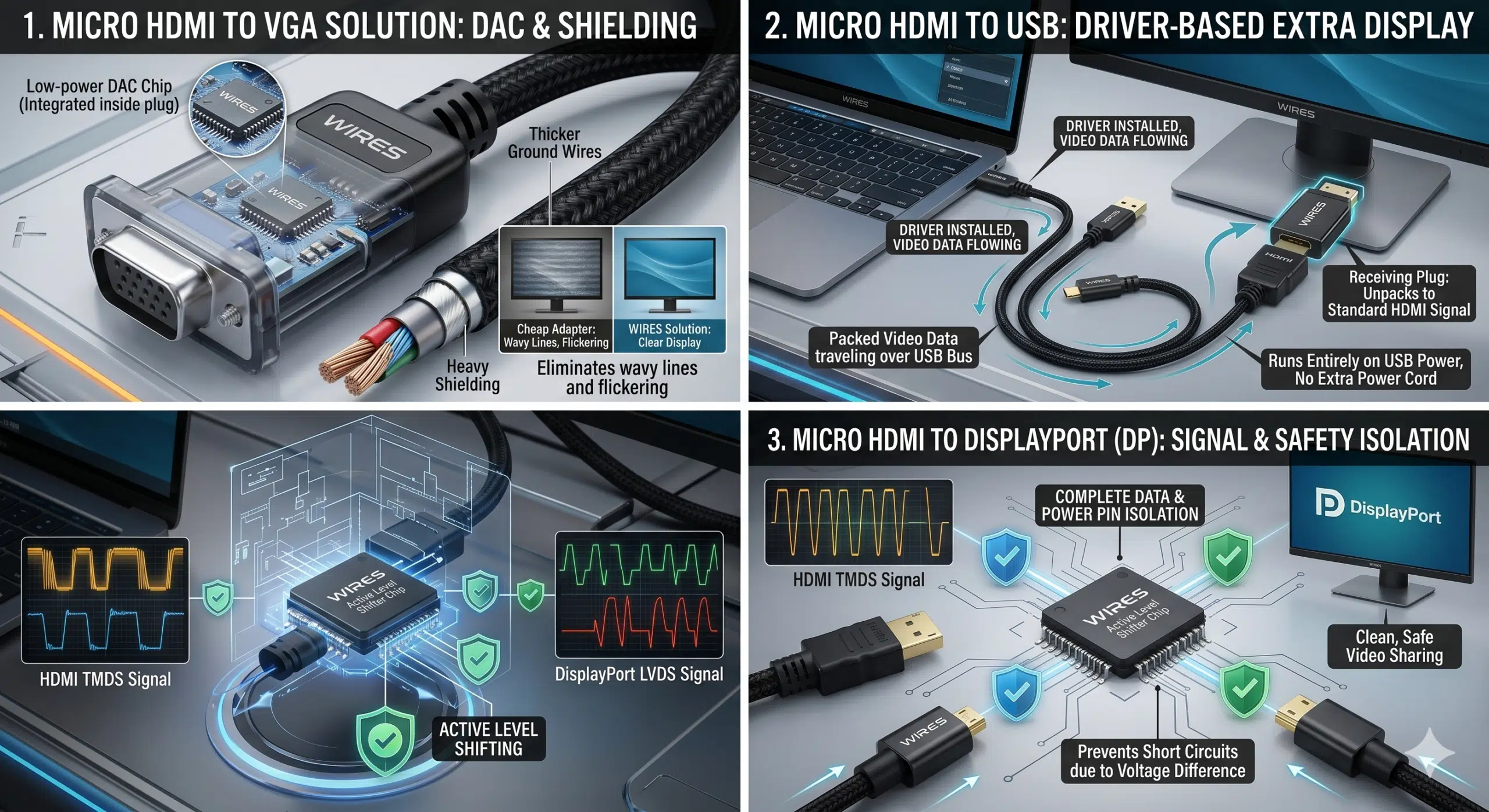
As a dedicated manufacturer with 28 years in the precision wire harness field, WIRES (Beijing JinHai) backs your project from your first concept sketch all the way to mass production.
Custom Molds & Angled Plugs: If your machine casing is too tight for a straight cable, we have ready-to-use 90-degree molds pointing up, down, left, or right. Our design team can take your 3D STP files and build custom-molded connector shells with specific wall thicknesses or integrated mounting ears.
Full Digital Lab Testing: Every single cable we ship goes through 100% digital continuity and high-voltage insulation tests. Our lab utilizes time-domain reflectometers (TDR) and network analyzers to meet strict IPC/WHMA-A-620 Class 3 standards, ensuring your solder joints hold up over a long service life.
Q1: What is the minimum order quantity (MOQ) for custom cables?
We love helping out during the R&D and prototyping stages. For fully custom designs or specialized screw locks, our MOQ is as low as 100 pieces. For standard runs, we can offer even more flexible options for sample batches.
Q2: What is your factory’s monthly capacity and turnaround time?
Our lean factory in Beijing runs multiple automated high-frequency welding and molding lines. We can produce up to 30,000 custom video cables a month. First-run engineering samples take just 3–5 business days if materials are ready, and bulk production orders typically ship in 2–3 weeks.
Q3: What exact physical parameters can I customize?
You can tailor almost every aspect of the cable to fit your engineering needs, as shown in the options below:
| Custom Category | Engineering Options & Range |
| Wire Gauge & Metal | Choose from 32 AWG down to 36 AWG; options include high-purity oxygen-free copper (OFC) or silver-plated copper wire. |
| Cable OD & Tolerance | Total outer diameter can be fixed anywhere from 3.0mm to 5.5mm, holding a tight tolerance of ±0.1mm. |
| Locking Screws | Precision M2 or M2.5 screws can be integrated on one or both sides; custom screw spacing and thread depth are fully supported. |
| Jacket Properties | Choose UL94 V-0 flame-retardant PUR for factory floors or bio-compatible medical silicone for sterile rooms. |
Q4: Why shouldn’t I just use a cheap consumer Micro HDMI cable on a factory floor?
Consumer lines are built thin and cheap to save costs. They skip heavy shielding braids and use standard PVC jackets that split open when exposed to machine oils or wide temperature swings. In a noisy, vibrating factory, a cheap cable will cause signal loss or break internally within days.
Q5: What are the core electrical performance benchmarks for WIRES industrial cables?
To give procurement and engineering teams peace of mind, every batch of WIRES cables matches the strict benchmarks below:
| Electrical & Physical Test | Technical Benchmark Standard | Engineering Value for Equipment Builders |
| Characteristic Impedance | 100Ω ± 10Ω | Eliminates signal reflection, wiping out screen artifacts and blackouts. |
| Intra-Pair Skew | ≤ 112 ps/m | Aligns channel timing perfectly, ensuring a flicker-free display. |
| Far-End Crosstalk (FEXT) | ≤ -26 dB (Up to 5.1GHz) | Minimizes signal bleeding when running multi-channel cables side by side. |
| Attenuation Loss | 300KHz–825MHz ≤ 8dB/10ft; 825MHz–2.475GHz ≤ 21dB/10ft | Controls the copper line’s natural drop to guarantee a complete high-bandwidth image. |
| Voltage & Dielectric Rating | Rated 40V AC; withstands 500V DC / 1 minute | Matches the electrical safety codes of industrial control cabinets and medical instruments. |
| Insulation Resistance | ≥ 100 MΩ·km (Tested at 20°C) | Prevents micro-current leakage between dense pins, extending cable life. |
| Operating Temperature | Static: -40°C to +85°C; Dynamic: -20°C to +80°C | Keeps the jacket flexible and crack-free in freezing outdoor setups or hot factories. |
Q6: In a high-speed drag chain setup, what is the expected lifespan of the cable?
WIRES optimizes the inner core layout and alloy conductor mix for continuous moving paths. Our production samples are proven to last under rigorous automated tests:
| Mechanical Test | Lab Benchmark Standard | Real-World Performance Value |
| Min. Bending Radius | Static setup: 4 × Cable OD; Moving track: 7.5 × Cable OD | Ultra-tight bend layout saves space and lets you rout wires around sharp enclosure corners. |
| Flex Life (Drag Chain) | Bend Angle: ±90°; Speed: 60 cycles/min; Clean runs: ≥ 5,000,000 cycles | Easily handles the non-stop, 24/7 movement of automated lines without inner wire breaks. |
| Tensile Strength | High-strength Kevlar fiber run down the core; Molded plug joint strength: ≥ 100N | Prevents cable damage or terminal pull-outs caused by maintenance pulls or rough handling. |
In industrial automation, machine vision, and medical imaging gear, Micro HDMI cables don’t just handle HD video transmission tasks—they directly impact system stability and uptime. As machinery shifts toward high resolution, small footprint, and dense integration, requirements for bandwidth, EMI shielding, and signal integrity will only keep rising.
Leveraging 28 years of specialized cable harness manufacturing, WIRES builds components strictly to IATF 16949, ISO 9001, and IPC/WHMA-A-620 standards. We provide reliable, custom Micro HDMI solutions for industrial, medical, and embedded vision setups. If you are tracking down a Micro HDMI cable targeted to your project needs, contact the WIRES engineering team today for expert technical reviews, quick engineering samples, and a free custom quote.
Enjoy a free sample worth up to $100!
Explore our custom services now. Leave your email, and we'll get intouch!
 English English
 Vietnamese
 Indonesian
 Arabic
 Spanish